Jujutsu Kaisen Tattoo Ideas: 8 Designs From Sukuna, Gojo, Megumi and More
Jujutsu Kaisen runs on visual shorthand. Sukuna’s markings, Gojo’s blindfold, the wheel above Mahoraga’s head and the shadow dogs Megumi casts with his hands are each recognizable from a single shape, which is what a tattoo needs. The harder choice is which detail to build on, and whether it still reads at the size and placement you have in mind.
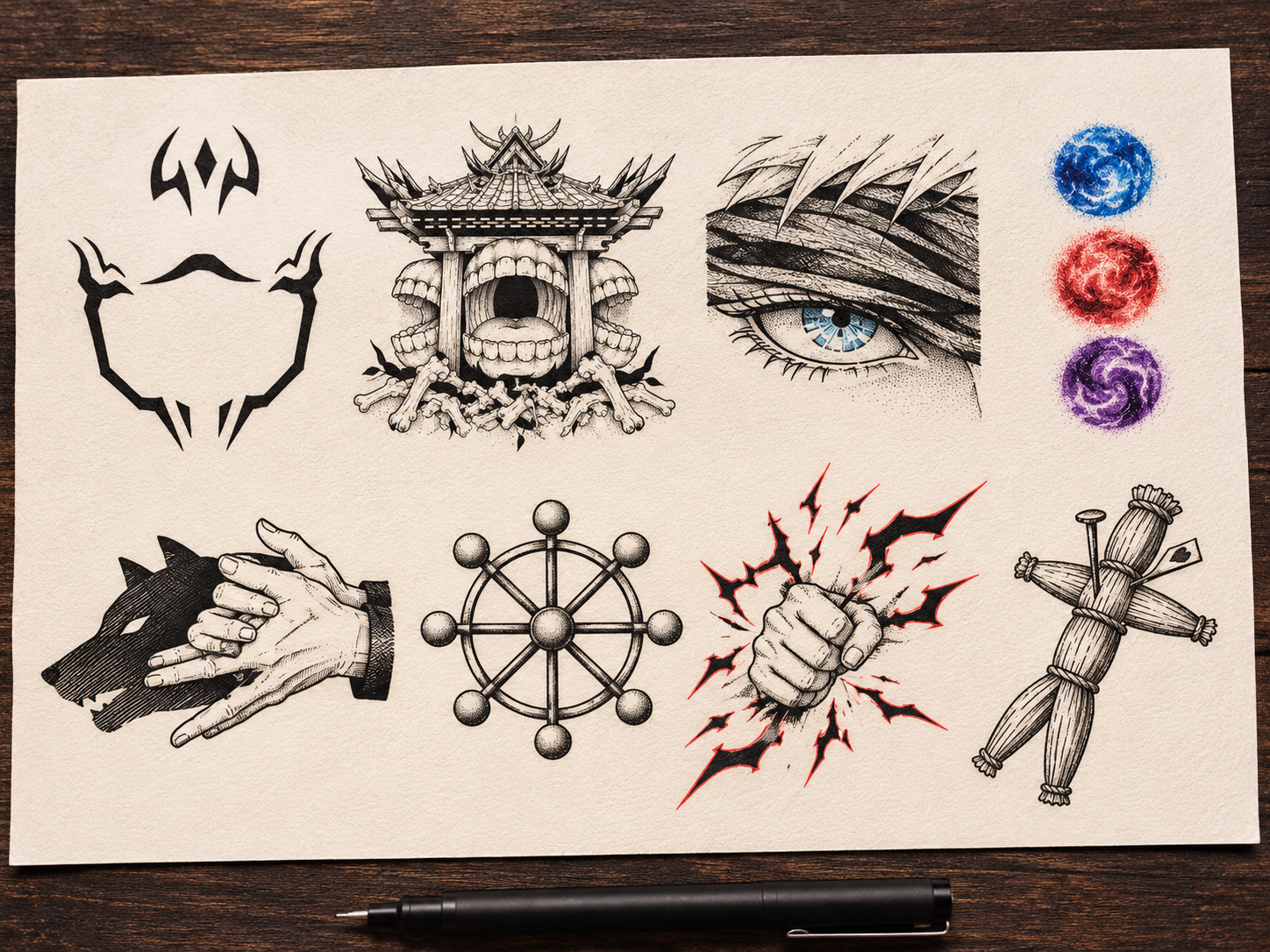
Below are eight original design concepts drawn from the series, followed by how to choose between a portrait, a technique symbol and a single mark, where each fits on the body, and which styles suit them. Treat every concept as a starting point to take to an artist, not a finished stencil.
Written by Ren Takahashi, Founder & Editorial Director, InkShonen. How we research and edit our articles.
8 Jujutsu Kaisen Tattoo Concepts
Each concept takes one element of the series and turns it into a design that works on skin. The notes under each give the size, placement and style it needs to stay readable.
1. Sukuna’s markings as a minimal line tattoo
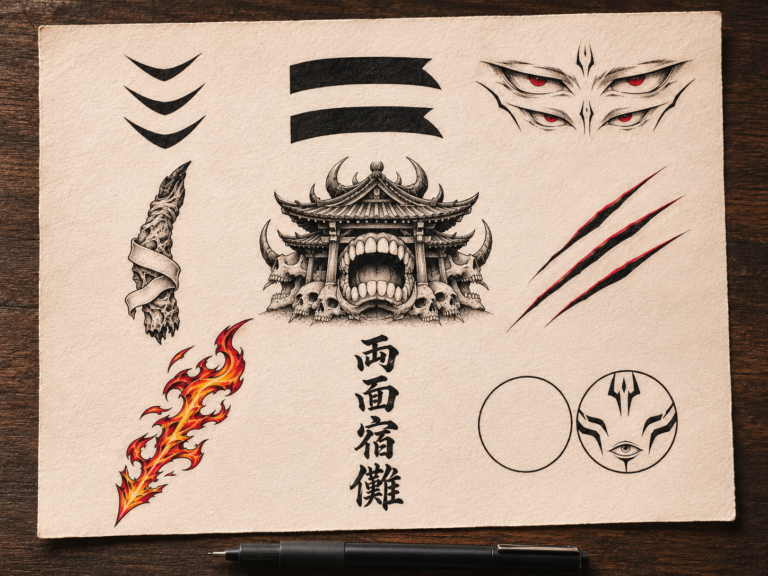
Sukuna’s facial markings are a set of bold lines and bands. Lifted off the face and redrawn as a short row of strokes, they become an abstract mark: fans of the series will place it, and everyone else reads it as a graphic. Keep the line count low. Two or three strokes hold up far better at small sizes than a full copy of the pattern. For nine more designs built from him, from his arm bands to Malevolent Shrine, see our Sukuna tattoo ideas.
- Size: 3 to 6 cm
- Placement: inner wrist, forearm, behind the ear
- Style: blackwork or bold fine-line
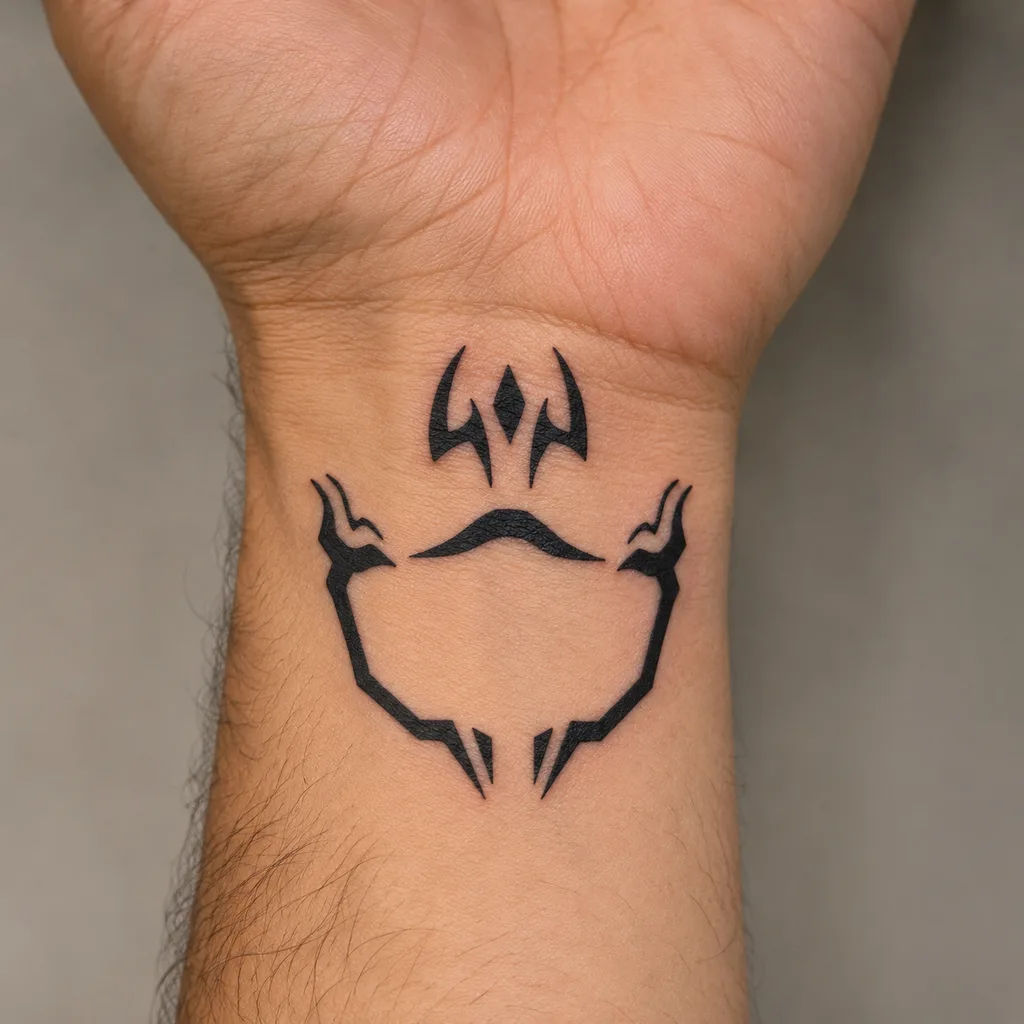
Illustrative concept images: AI-generated artwork created to explore tattoo design ideas. They do not represent verified tattoos performed on real clients.
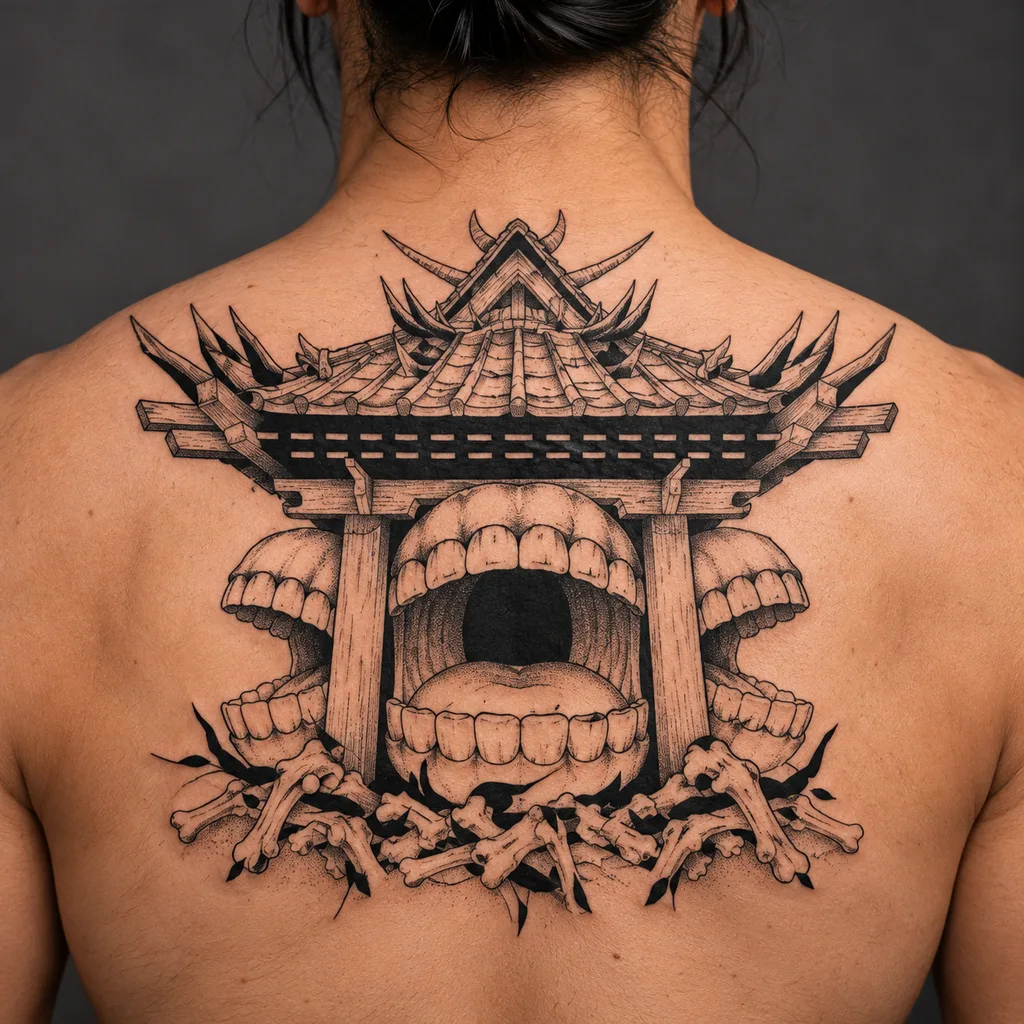
2. Sukuna’s finger and the Malevolent Shrine
The story starts with one of Sukuna’s fingers, a cursed object Yuji swallows to protect his friends. As a tattoo, a single wrapped finger is a small, dark reference that only fans will recognize. At a larger scale, the shrine from his Domain Expansion, Malevolent Shrine, gives a back or upper-arm piece a strong silhouette: a temple roofline framed by teeth and bones, worked in heavy black.
- Size: finger 5 to 8 cm; shrine 15 cm and up
- Placement: forearm for the finger; upper arm, back or thigh for the shrine
- Style: blackwork with dotwork shading
3. Gojo’s blindfold and Six Eyes
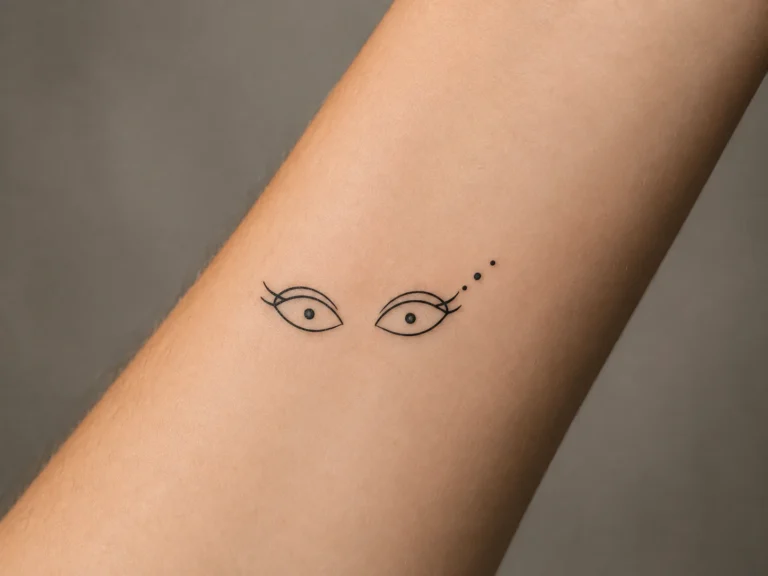
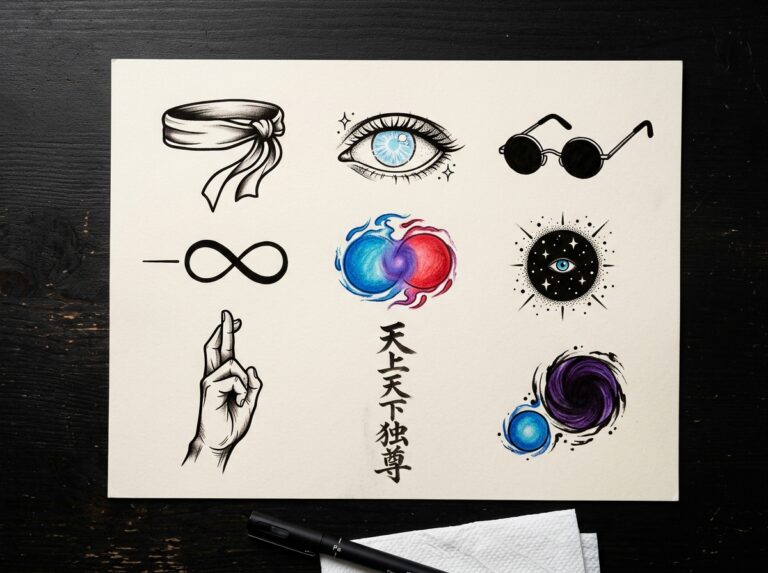
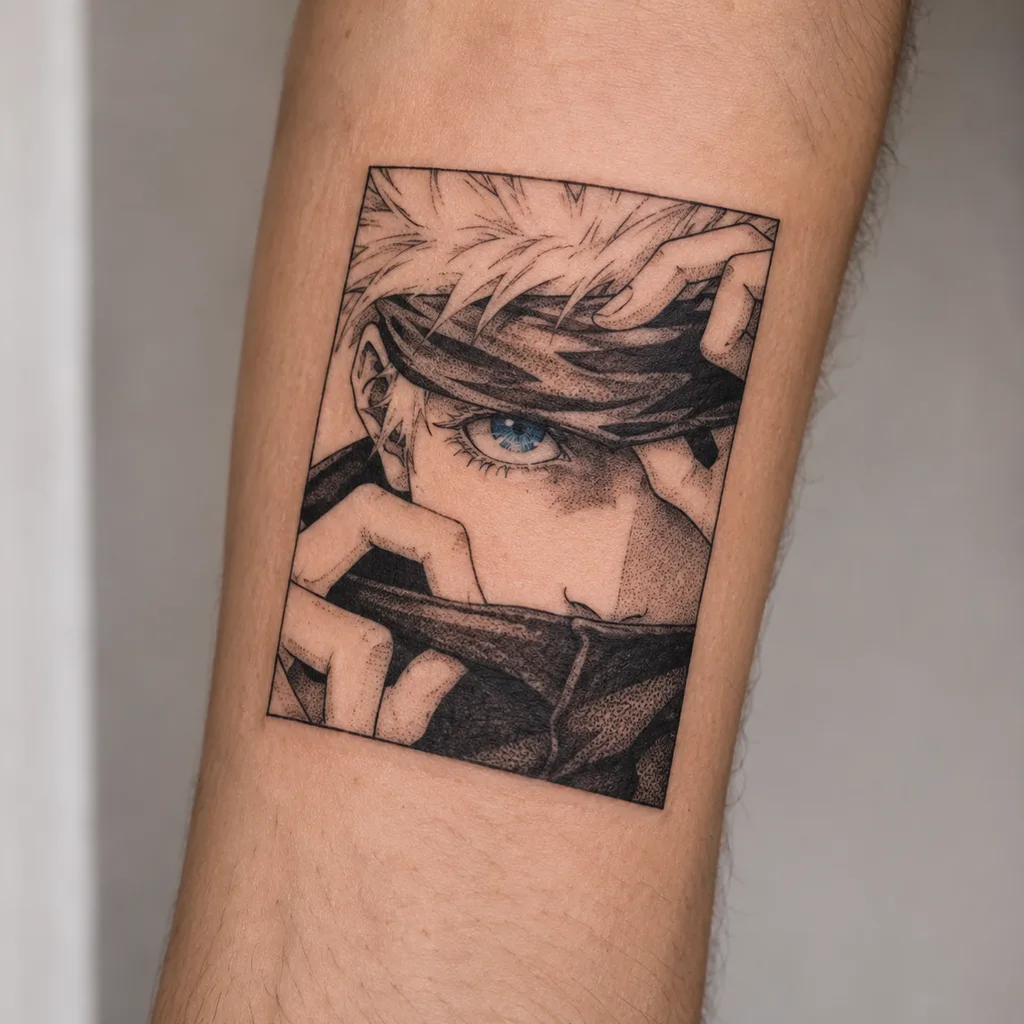
Gojo is usually drawn with his eyes covered, so the moment the blindfold comes off carries a lot of weight in the series. A fine-line design can play on that: a band of cloth across the top of the frame with one bright eye beneath it, or the eye alone with the pale, star-like iris of the Six Eyes. Keep the iris simple, because very fine radial lines tend to blur as a tattoo ages. For nine Gojo designs, from his sunglasses to Unlimited Void, see our Gojo tattoo ideas.
- Size: 6 to 10 cm
- Placement: inner or outer forearm, upper arm
- Style: fine-line, with an optional single blue accent
4. Red, Blue and Hollow Purple
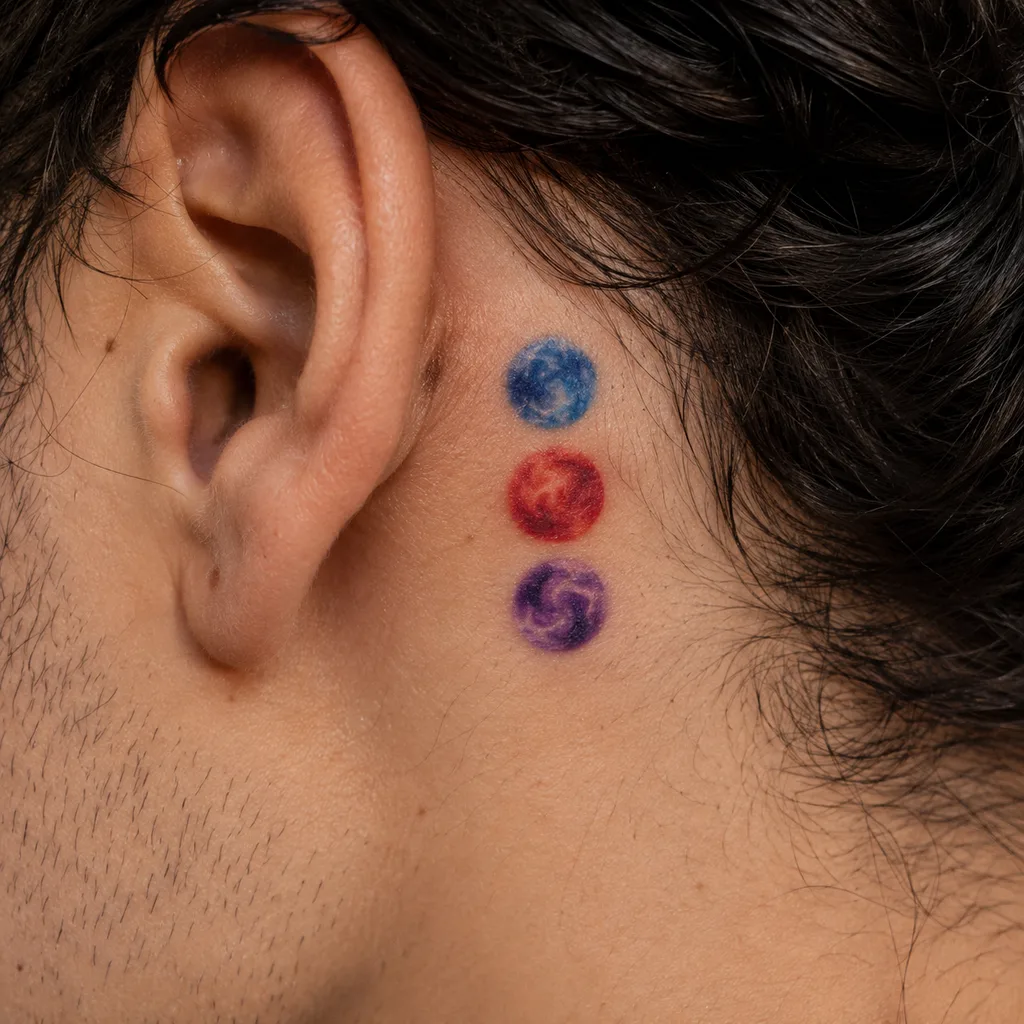
Gojo’s Limitless technique has three named expressions: Blue pulls, Red repels, and Hollow Purple combines the two. Three small orbs in blue, red and violet, stacked or set in a short line, make a quiet color tattoo that looks abstract to everyone except fans. It is one of the few Jujutsu Kaisen ideas that works best in color. Artists commonly suggest making each dot slightly larger than you first picture, so the color has room to hold.
- Size: 1 to 2 cm per orb
- Placement: wrist, ankle, behind the ear, along the spine
- Style: color with soft edges
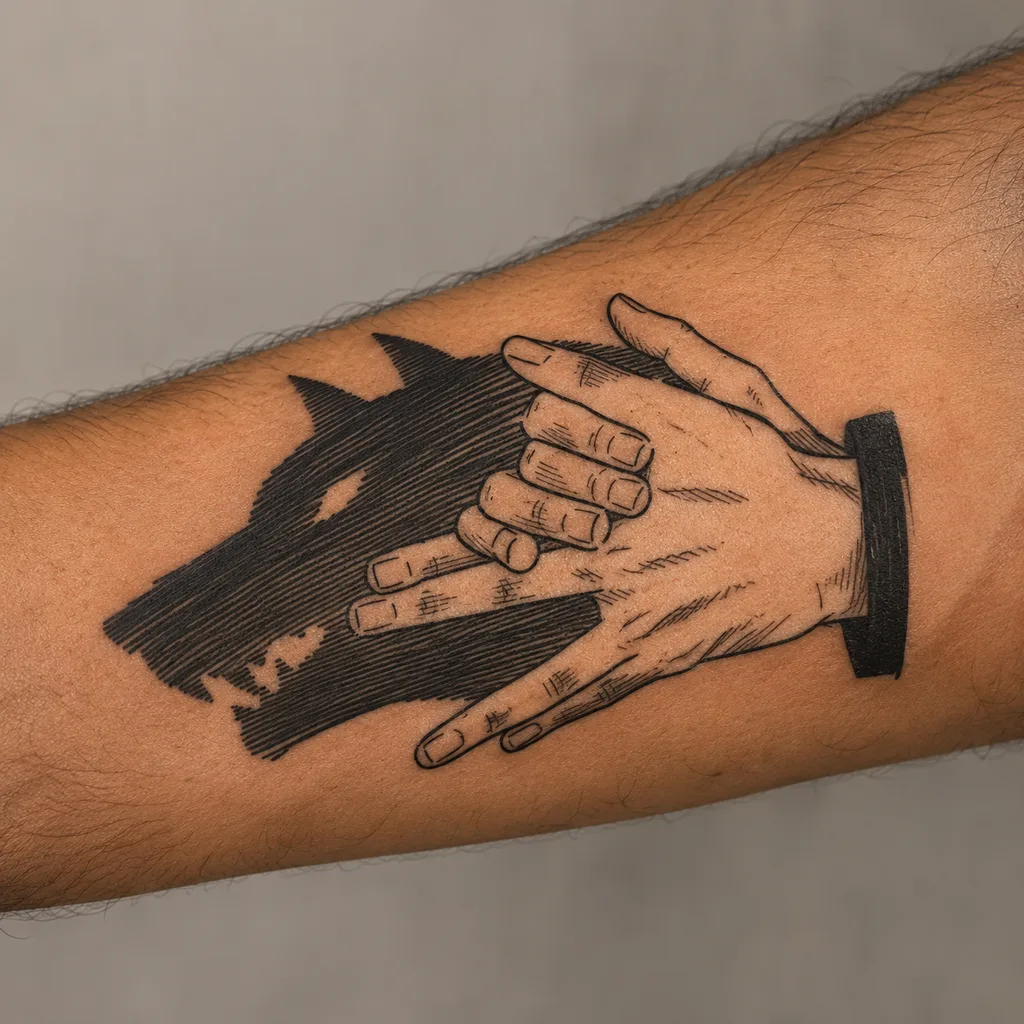
5. Megumi’s Divine Dogs as a shadow design
Megumi’s Ten Shadows technique summons shikigami through hand signs, and the first he uses are the Divine Dogs, one white and one black. A tattoo can show the hand sign casting a dog’s shadow, or the two dogs facing each other in black ink and bare skin. The contrast between the pair is the design, so it suits blackwork more than color.
- Size: 8 to 12 cm
- Placement: outer forearm, calf
- Style: blackwork with negative space
6. Mahoraga’s wheel
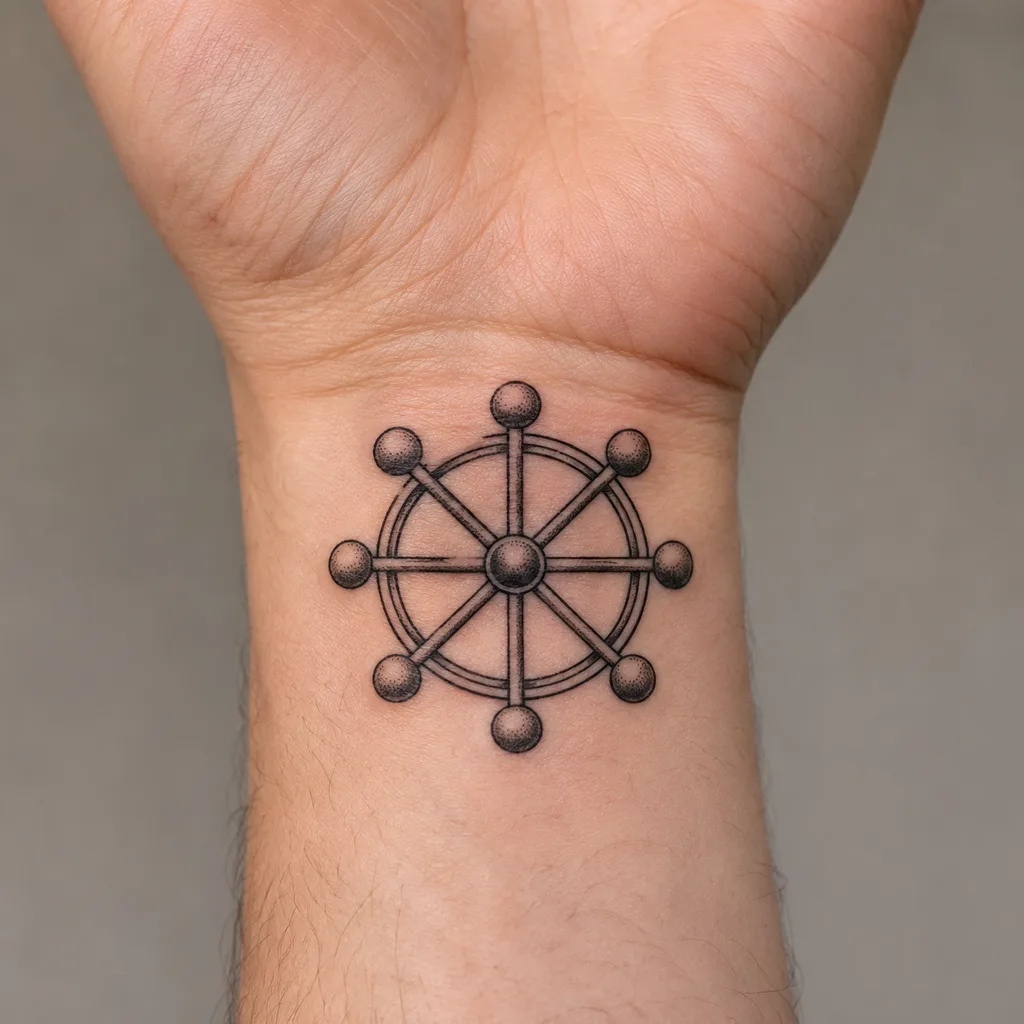
The eight-handled wheel above Mahoraga’s head turns each time it adapts to an attack, which makes it an easy symbol for adapting to whatever comes. It is a clean, symmetrical shape that scales well, from a small wheel on the wrist to a large piece between the shoulder blades.
- Size: 3 cm (wrist) to 15 cm (upper back)
- Placement: wrist, back of the neck, upper back
- Style: blackwork or geometric fine-line
7. Yuji’s Black Flash
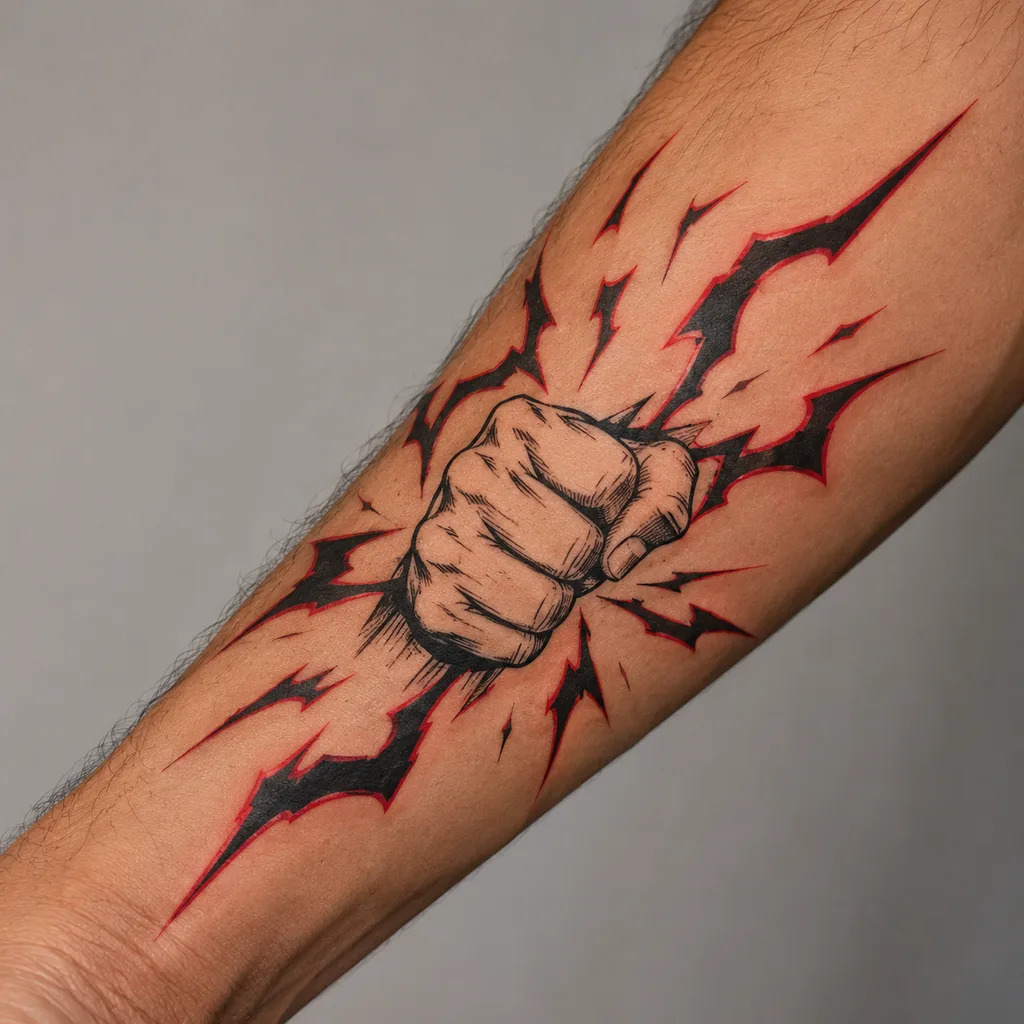
Black Flash happens when cursed energy hits within a millionth of a second of a physical strike, and the anime shows it as black lightning with a red edge. Drawn as a burst of jagged black sparks, on its own or around a closed fist, it gives a Yuji tattoo movement without showing his face.
- Size: 8 to 15 cm
- Placement: forearm, calf, upper arm
- Style: blackwork, with an optional red accent
8. Nobara’s straw doll and nails
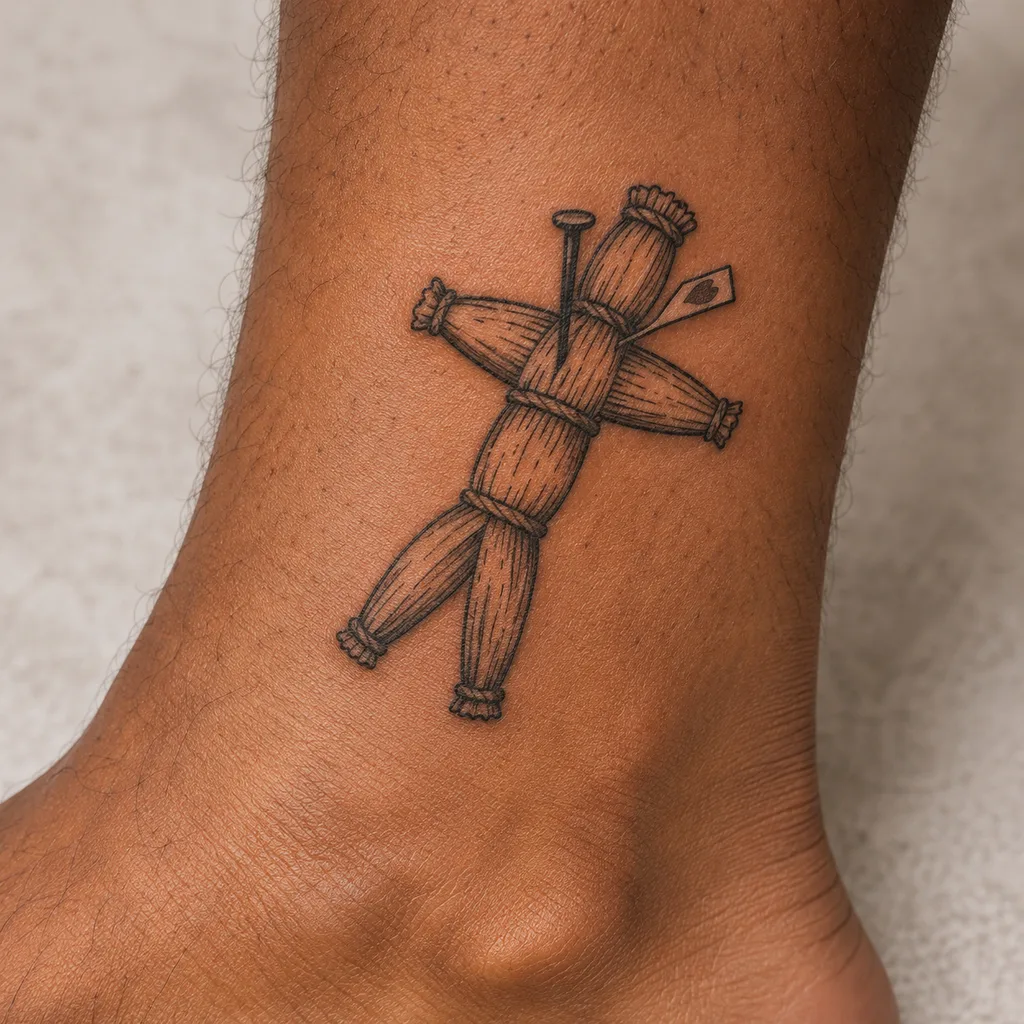
Nobara fights with a hammer, nails and a straw doll, using the doll in her Straw Doll Technique to strike a target from a distance. A doll pierced by a single nail is a small, slightly eerie design that still reads at a few centimeters, and it pairs naturally with a hammer for a two-part piece.
- Size: 4 to 7 cm
- Placement: ankle, inner arm, behind the ear
- Style: fine-line, or traditional with bold outlines
Portrait, Symbol or Mark: Choose the Category First
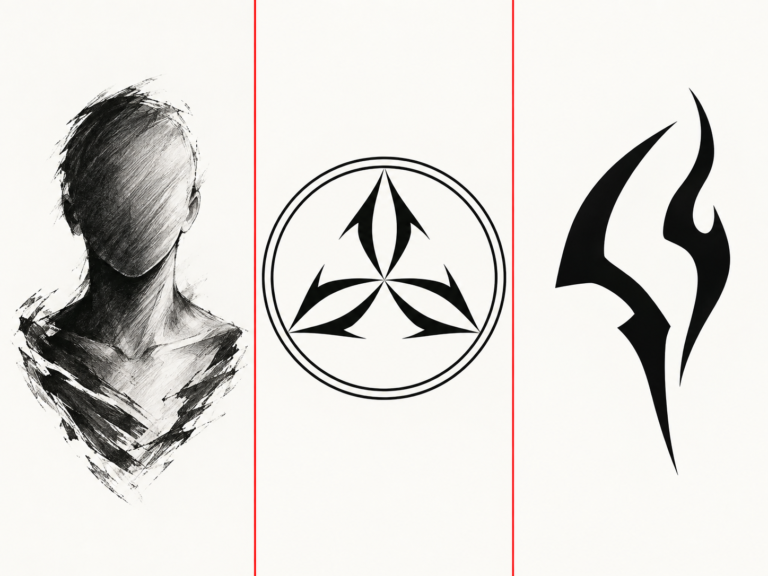
A tattoo of “Sukuna” can mean three very different things: his face, a pattern from his technique, or one small recognizable detail. Each asks for different space and a different kind of skill, so settling the category first saves you from picking a placement the design cannot fit.
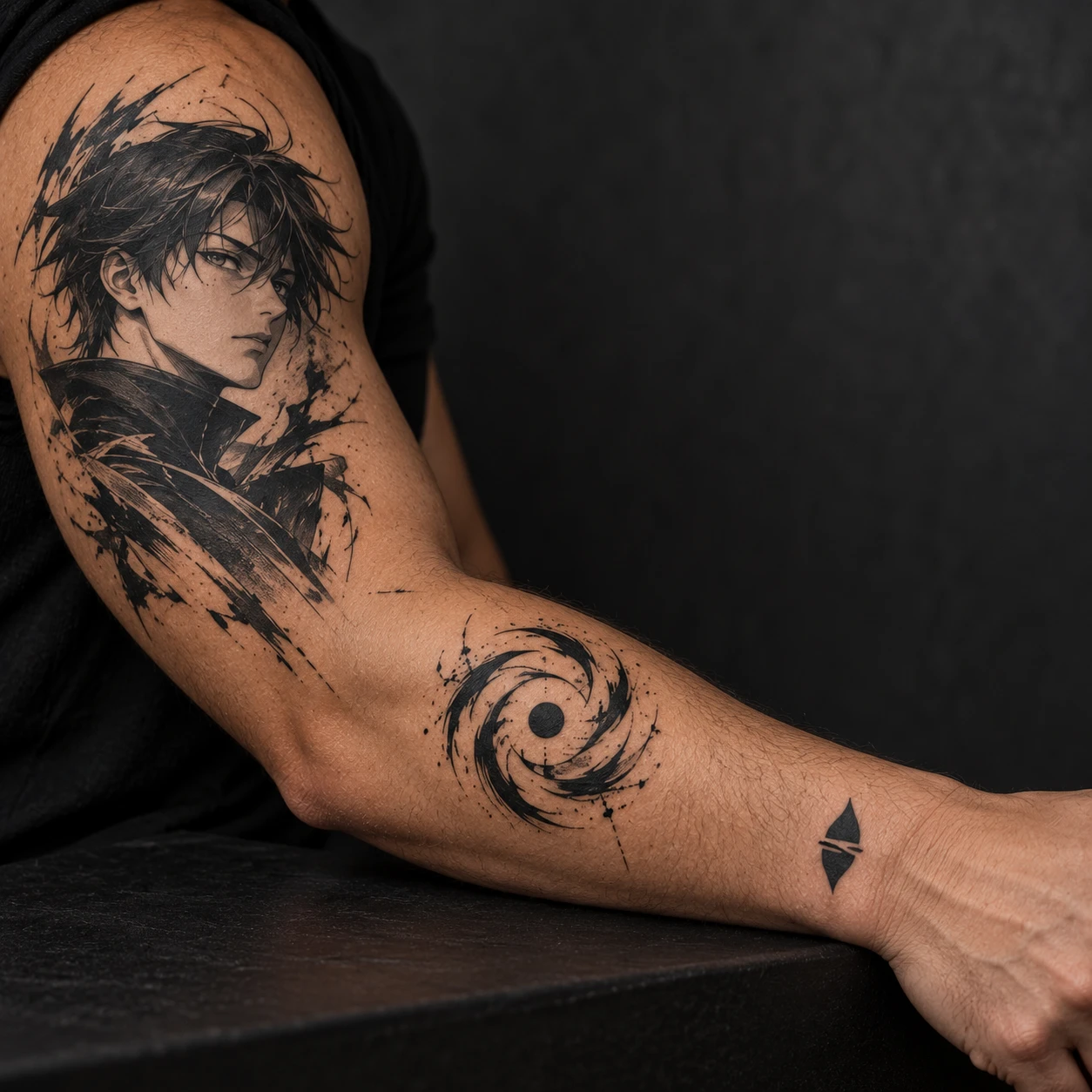
Character portrait
A portrait renders a character’s face and expression, inspired by their design rather than copied from official art. It depends on the eyes, the hair and the expression, all of which need room. It is also the category where the artist’s skill matters most, because a likeness that is slightly off is obvious. Look at healed portraits in a candidate artist’s portfolio before you commit.
Cursed technique symbol
This turns the look of an ability, such as Hollow Purple, the Divine Dogs or a Domain Expansion, into a standalone graphic. Symbols don’t rely on a face, so they can be redrawn at several sizes without losing what makes them recognizable. They suit people who want the reference to be understood by fans without a character’s likeness doing the work.
Signature mark
A signature mark takes one distinctive detail tied to a single character, such as a blindfold, a facial marking or a weapon, and leaves out the rest. It sits between the other two: more specific than an abstract symbol, far simpler than a portrait. It is also the lowest-commitment way to start if this is your first anime tattoo.
What a Design Can Be Built From, Character by Character
The table lists visual elements commonly associated with each character and the category they suit. The placements are starting points: a body area that can hold the design at the size the detail needs. Check your own reference in the manga or anime, since details differ between versions.
| Character | Elements a design can be built from | Category that suits it | Starting point for placement and size |
|---|---|---|---|
| Sukuna | Facial markings, the extra pair of eyes, his fingers, Malevolent Shrine | Portrait, or a mark using the markings alone | Portrait: forearm, upper arm or back, larger. Mark: wrist or forearm, small to medium |
| Gojo Satoru | Blindfold and Six Eyes; Blue, Red and Hollow Purple; Unlimited Void | Mark or symbol; portrait if the eyes are the focus | Forearm or upper arm, medium; orbs small |
| Yuji Itadori | Black Flash, Sukuna’s markings when Sukuna surfaces | Symbol or mark | Forearm or calf, medium |
| Megumi Fushiguro | Divine Dogs, the hand signs of Ten Shadows | Symbol | Forearm or calf, medium |
| Nobara Kugisaki | Hammer, nails, straw doll | Mark | Ankle, wrist or forearm, small |
| Toji Fushiguro | Scar at the corner of the mouth, the Inverted Spear of Heaven | Portrait, or a weapon-based mark | Forearm, thigh or upper arm, medium to large for a portrait |
| Nanami Kento | The 7:3 ratio line, suit and tie details | Mark | Forearm or upper arm, small to medium |
| Mahito | Stitched seams and a distorted body outline | Symbol or mark | Wrist, forearm or behind the ear, small to medium |
| Yuta Okkotsu | Katana and the cursed spirit Rika | Portrait or symbol | Forearm or upper arm, medium |
| Choso | Blood-based technique, the pattern across his face | Symbol or mark | Wrist or forearm, small to medium |
| Mahoraga | The wheel above its head, the eight-handled sword | Symbol | Wrist (wheel only), back or upper arm, medium to large |
| Aoi Todo | The clap used in his technique, his build and scars | Mark; portrait for a larger piece | Upper arm or back, medium to large |
The table is based on how much detail a design contains, not how famous the character is. A face with fine features needs the most room, a seal or emblem needs the least, and a single marking falls between.
Placement and Size: Matching Detail to Space
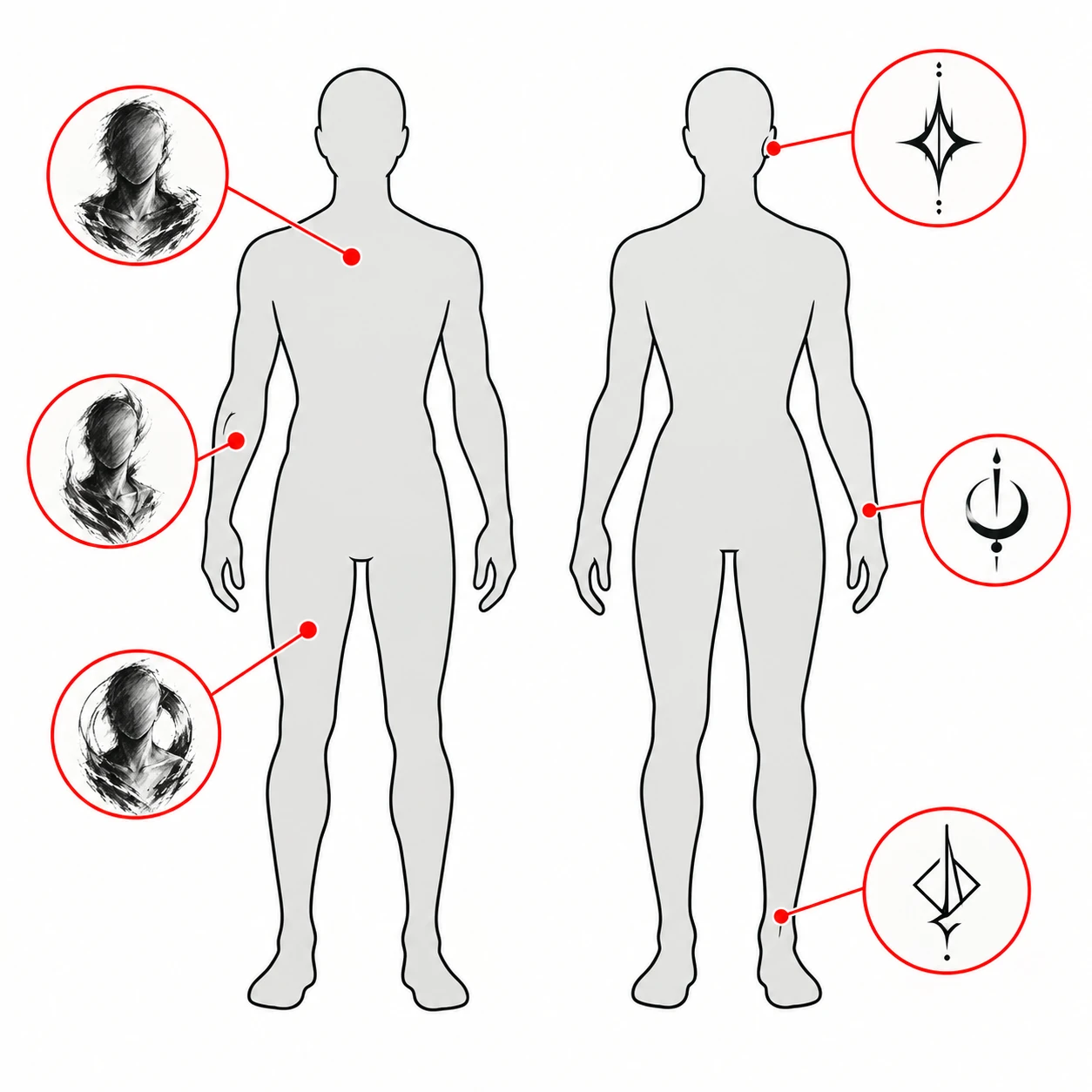
The rule of thumb is simple: the more fine detail a design has, the larger the area it needs. Large, flat areas such as the outer forearm, upper arm, back and thigh give a portrait room. Symbols and marks fit smaller areas such as the wrist, ankle or behind the ear. For a broader look at how placement affects design choices, read our guide to the best placement for an anime tattoo, or the pieces on forearm, wrist and sleeve designs.
Two practical checks help. First, ask your artist to show you the design at the actual size, on paper or a stencil, before the needle touches skin. Second, consider how the design sits where other people will see it, since a placement you only see in a mirror is easier to commit to than one in daily view. If detail is the issue, enlarging the design or simplifying it are both better than shrinking a portrait until it loses its features.
Style: Fine-Line, Blackwork or Color
Style follows from the category, but artists differ in how they apply each style, so treat the pairings below as a starting conversation.
- Fine-line suits symbols and marks built from clean shapes, such as Gojo’s eye or Nobara’s doll, because thin lines suit simple geometry. It leaves little room for error, so choose an artist who regularly does it.
- Blackwork suits high-contrast designs such as Mahoraga’s wheel, the Divine Dogs or Black Flash, where solid black shapes carry the design rather than fine shading.
- Color and realism suit portraits and the Hollow Purple orbs, where tone is what makes the design read.
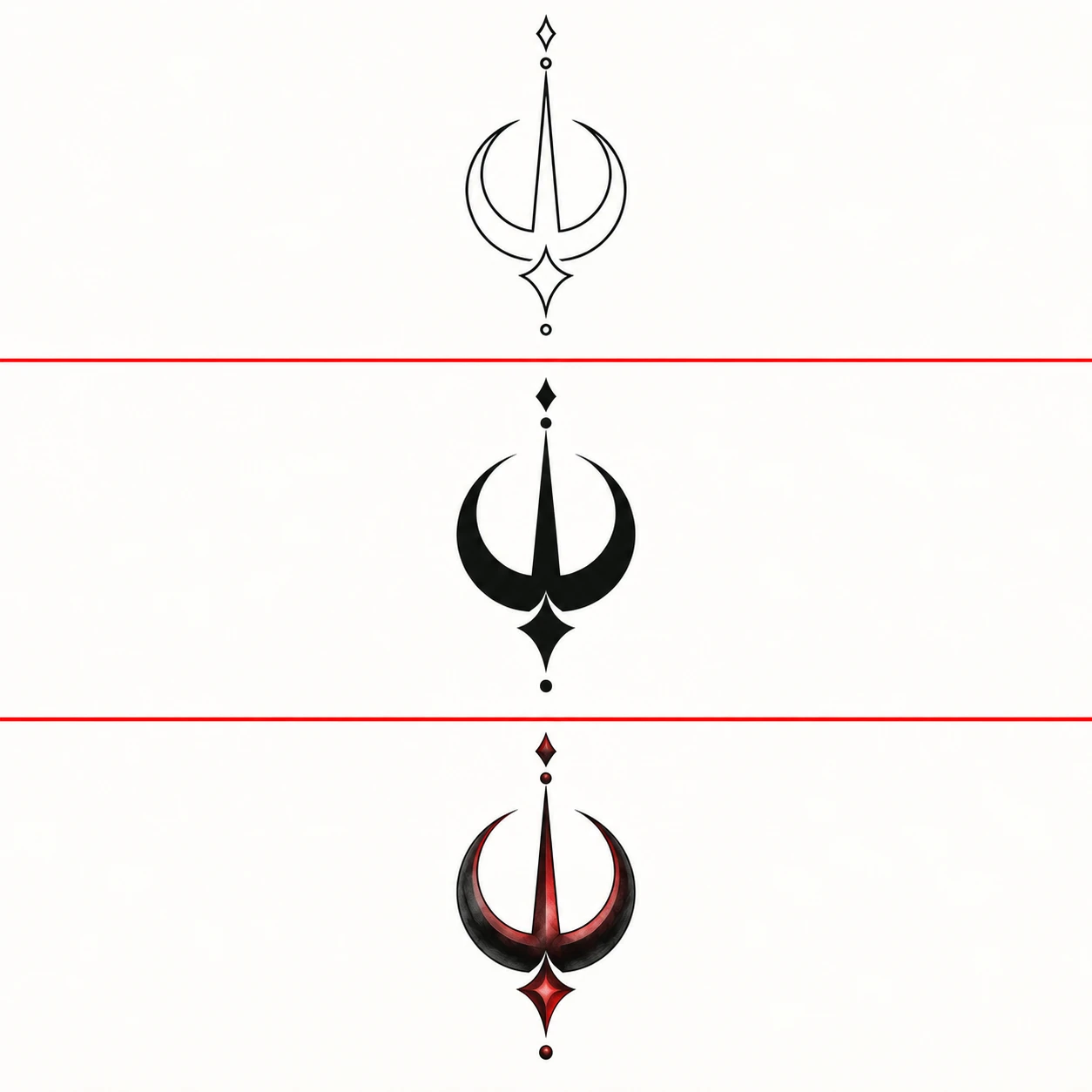
Whatever the style, ink exposed to the sun can fade. The American Academy of Dermatology advises protecting tattooed skin with a broad-spectrum, water-resistant sunscreen of SPF 30 or higher (AAD guidance as reported by Healio). The same guidance applies to a first tattoo and to one you have had for years, so factor in your usual sun exposure when you choose where the design goes.
Before You Book
- Decide the category first, then the character, then the size.
- Bring several references and expect the artist to redraw them as an original design rather than trace one image. See how to design a custom anime tattoo.
- Ask to see healed work in the style you want. Our guide to finding an anime tattoo artist covers what to look for.
- Check pricing and sessions early: a large portrait costs more and takes longer than a small mark (see how much an anime tattoo costs).
- Plan aftercare in advance. Our aftercare guide and what to know before getting an anime tattoo cover the steps.
- Remember that a tattoo can make it harder to see changes in the skin underneath; the AAD notes this in its page on tattoos and skin cancer.
FAQ
What does a Jujutsu Kaisen tattoo mean?
It depends on the category. A portrait expresses a connection to a specific character. A technique symbol such as Hollow Purple or Mahoraga’s wheel points to an ability or idea without showing a face. A signature mark is recognizable to fans but more restrained.
Which Jujutsu Kaisen tattoo ideas work best small?
Designs built from one simple shape: Mahoraga’s wheel, Nobara’s straw doll, the three Limitless orbs, Nanami’s 7:3 line or two or three of Sukuna’s marking strokes. Portraits and the Malevolent Shrine need more room to keep their detail.
Can I get a Jujutsu Kaisen tattoo without a character’s face?
Yes. Most of the concepts above use a technique, an object or a marking instead of a face, which also makes them easier to scale and less dependent on an artist’s portrait skill.
How do I make sure my design is original?
Bring several references and ask your artist to draw a new design from them rather than trace official art or another person’s tattoo. A redrawn design also fits your placement better than a copied image.
Jujutsu Kaisen tattoo ideas on this page are original, fan-inspired concepts. InkShonen is an independent resource and is not affiliated with, endorsed by, or sponsored by the creators, publishers, or rights holders of Jujutsu Kaisen.
Related reading: see the same size-and-placement thinking applied to Demon Slayer, Chainsaw Man, Solo Leveling and Spy x Family designs; anime eye tattoo ideas for more on drawing eyes like Gojo’s; and small anime tattoo ideas and matching anime tattoo ideas. For more character-driven designs, browse the Anime collection.