Sukuna Tattoo Ideas (Jujutsu Kaisen): 9 Designs From His Markings to Malevolent Shrine
Ryomen Sukuna is the only Jujutsu Kaisen character who already looks tattooed. The black lines under his eyes, the bands around his arms and torso and the second pair of eyes that opens when he takes over Yuji’s body read like ink before an artist touches them. That makes Sukuna tattoos unusually easy to scale: a few strokes of his markings work at three centimeters, and his domain, Malevolent Shrine, can fill a back.
Below are nine original Sukuna tattoo concepts with the size, placement and style each one needs, a table for choosing between them, and what to plan for with heavy blackwork. For designs drawn from the wider series, see the Jujutsu Kaisen tattoo ideas guide.
Written by Ren Takahashi, Founder & Editorial Director, InkShonen. How we research and edit our articles.
9 Sukuna Tattoo Concepts
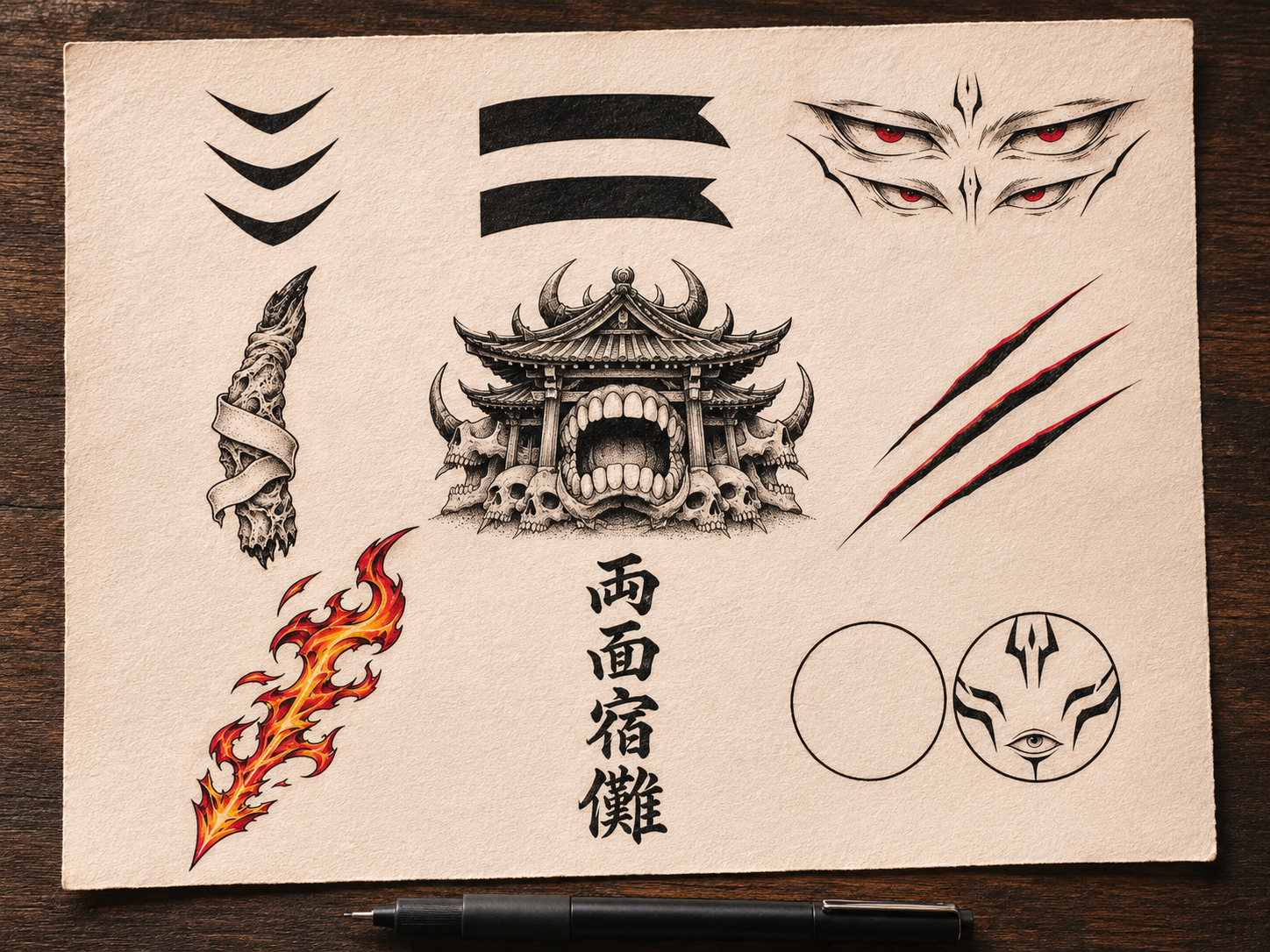
1. The facial markings as a minimal line tattoo
When Sukuna surfaces, lines appear under Yuji’s eyes and across his face. Taken off the face and redrawn as two or three short, slightly curved strokes, they become an abstract mark that fans place instantly and everyone else reads as a graphic. Fewer strokes hold up better: a full copy of the pattern at wrist size closes up as the lines spread over the years.
- Size: 3 to 6 cm
- Placement: inner wrist, side of the finger, behind the ear
- Style: bold blackwork lines
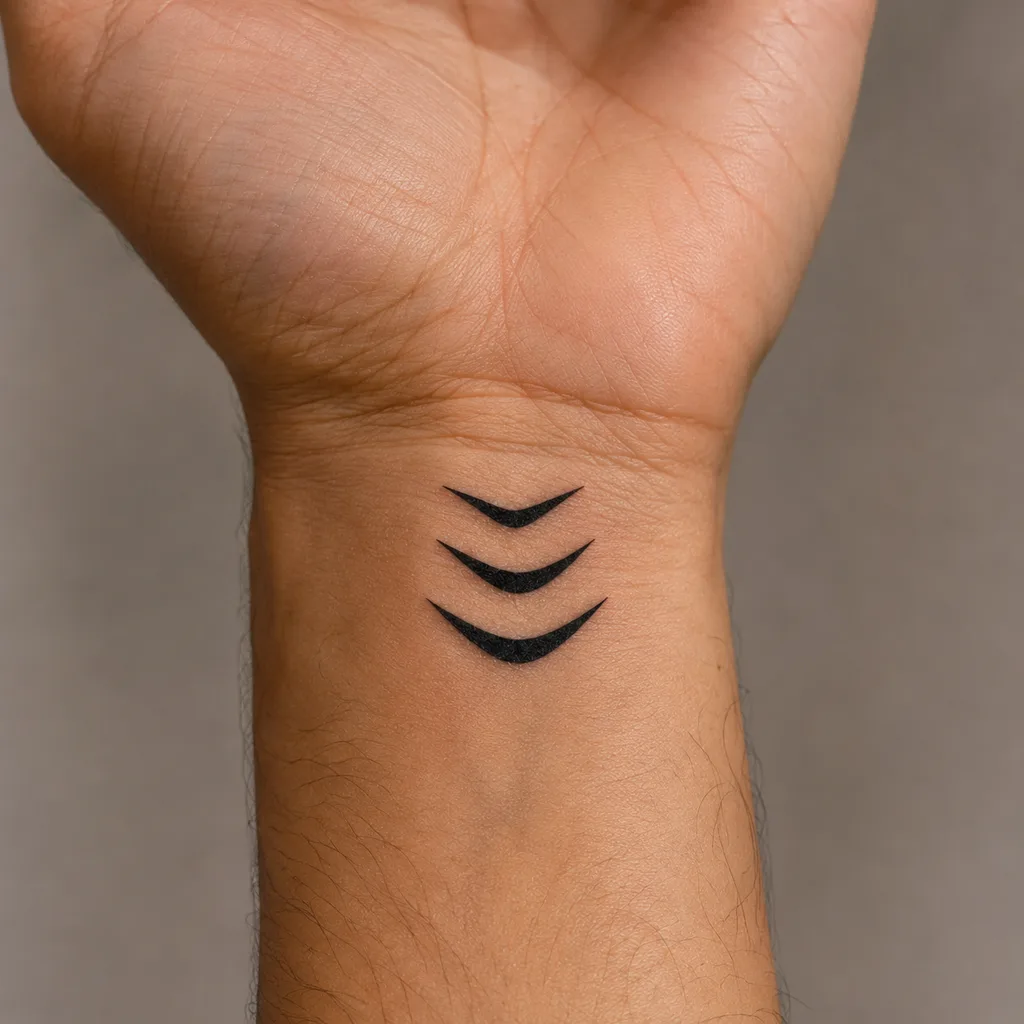
Illustrative concept images: AI-generated artwork created to explore tattoo design ideas. They do not represent verified tattoos performed on real clients.
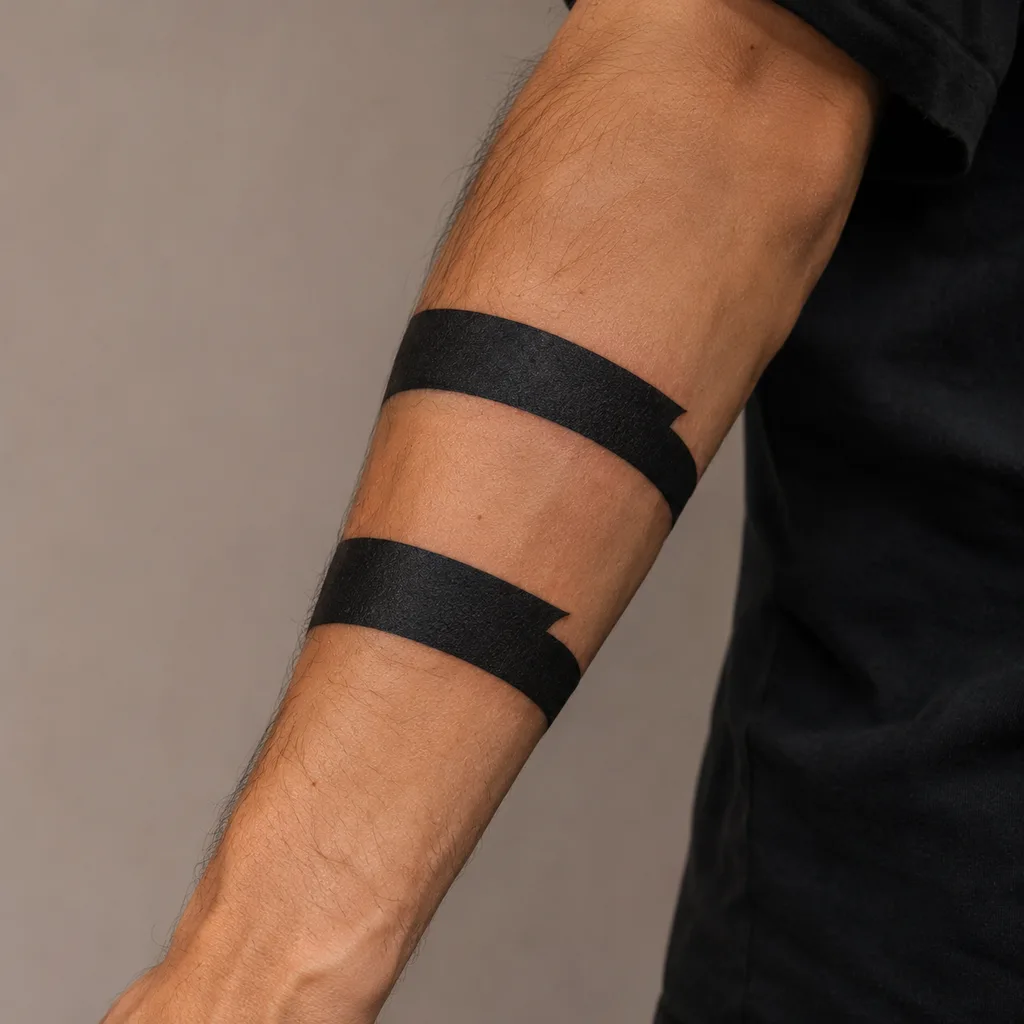
2. Arm bands
Sukuna’s markings don’t stop at his face. Thick black bands wrap his wrists and forearms, which happens to be one of the oldest tattoo formats there is. Two or three bands around the forearm, with the slightly pointed ends his markings have, give you a Sukuna tattoo that wraps the arm instead of sitting on it. Bands need an artist who can keep solid black even all the way around, so ask to see healed band work.
- Size: 2 to 4 cm band width, full wrap
- Placement: forearm, wrist, upper arm
- Style: solid blackwork
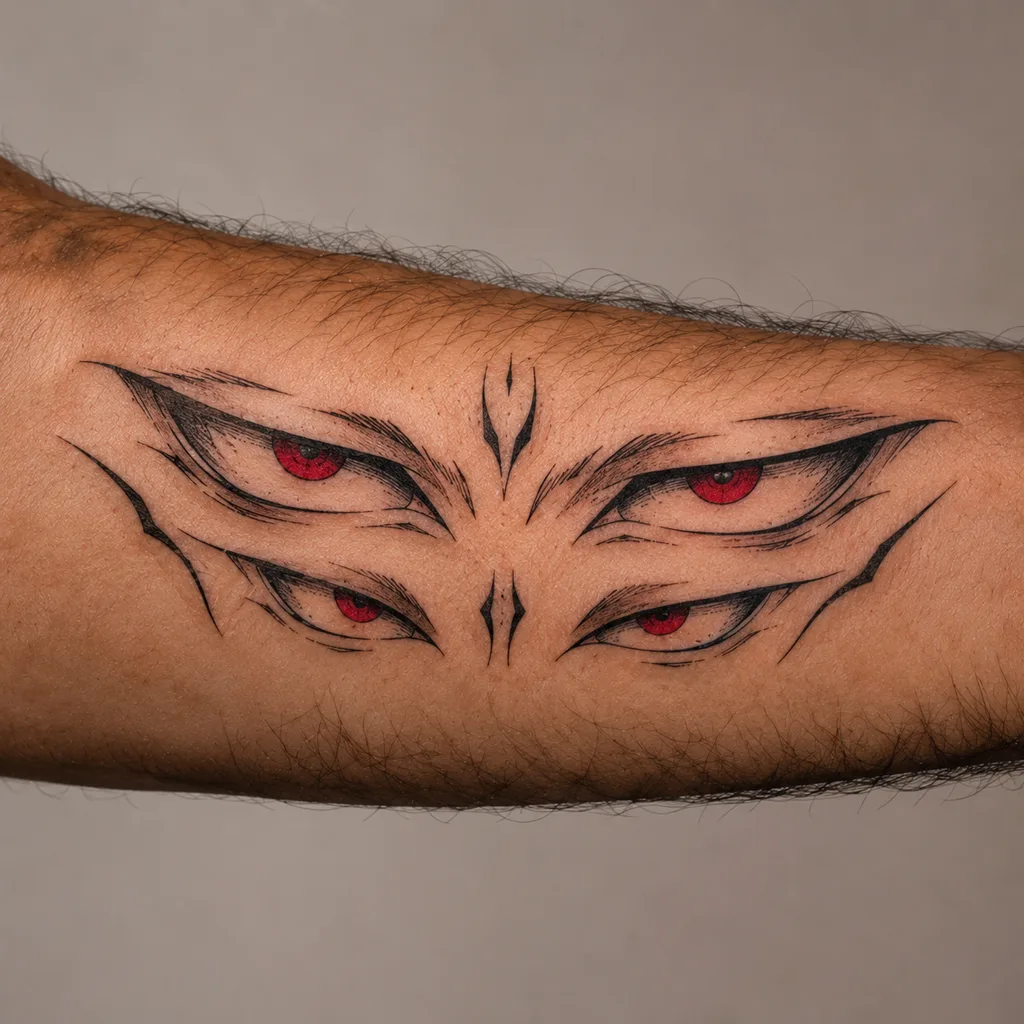
3. The four eyes
The detail that tells you Sukuna is in control is the second pair of eyes opening beneath the first. As a tattoo, two stacked pairs of narrow eyes with the marking lines between them is unsettling in a way that suits the character, and it carries no face around it. Keep the lower eyes slightly smaller so the design reads as two rows rather than a pattern.
- Size: 7 to 12 cm wide
- Placement: outer forearm, back of the arm, upper chest
- Style: blackwork, with an optional deep red iris
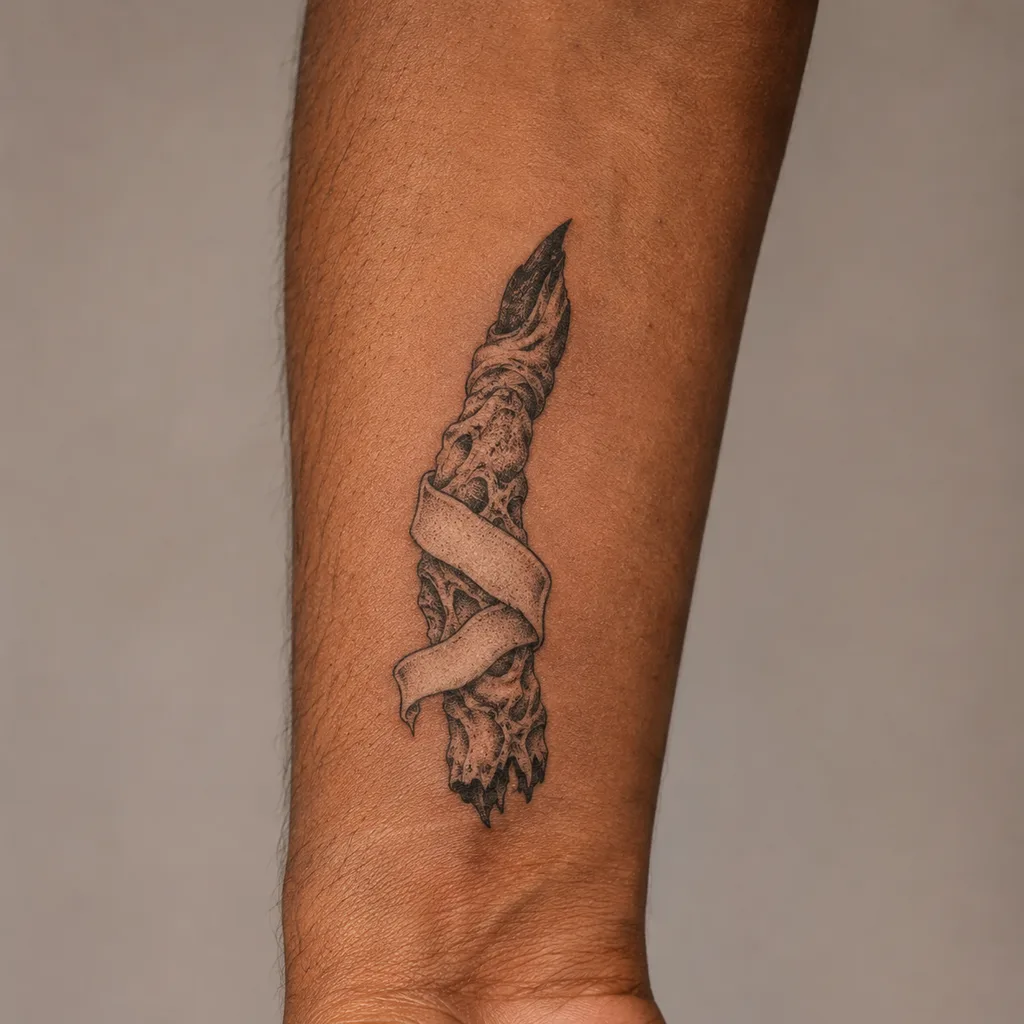
4. A cursed finger
Sukuna’s power is split across twenty fingers, kept as cursed objects, and the story begins when Yuji swallows one to protect his friends. A single shriveled finger wrapped in a talisman strip is a small, dark design that only fans will recognize. Some people add a short tally of marks beside it to count fingers, which works best as a separate small element rather than crowding the finger itself.
- Size: 4 to 8 cm
- Placement: inner forearm, side of the hand, ankle
- Style: black and grey with dotwork shading
5. Malevolent Shrine
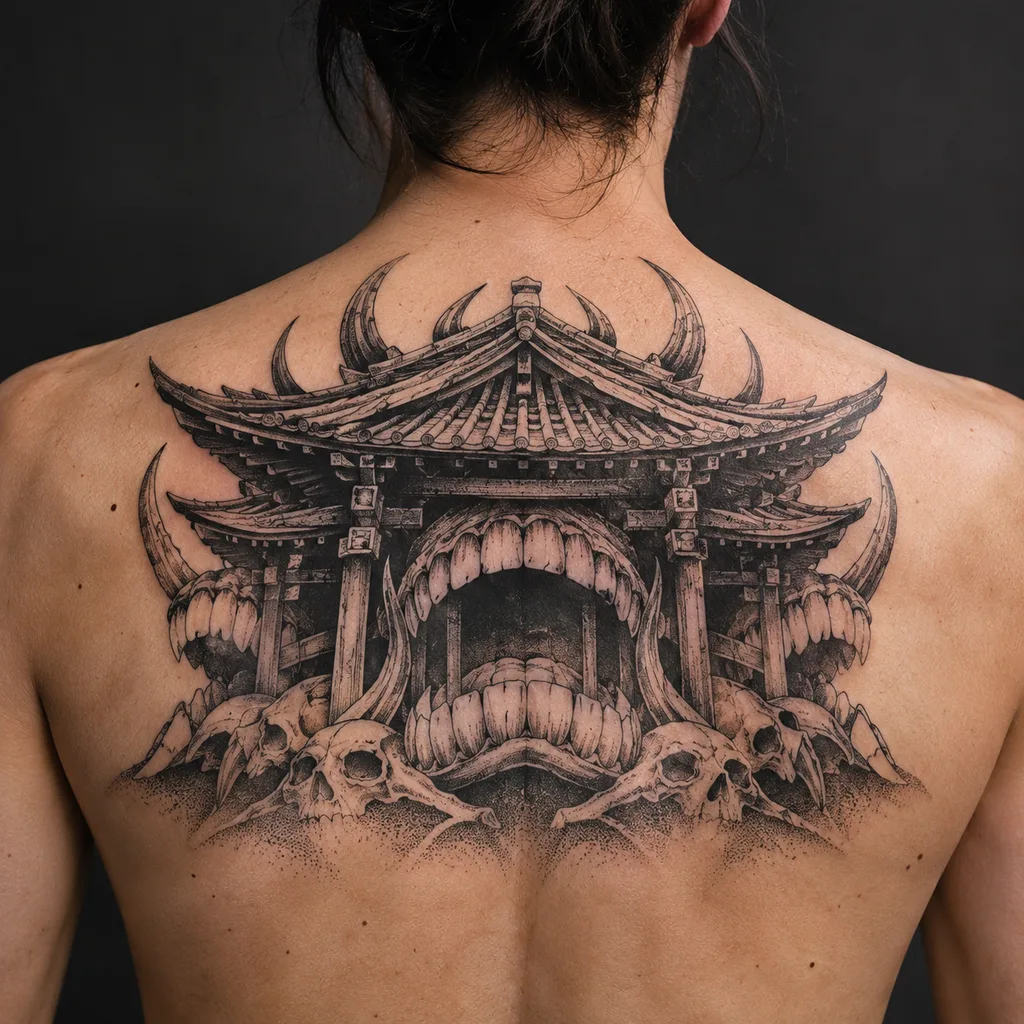
Sukuna’s Domain Expansion, Malevolent Shrine, is a shrine built from mouths, teeth and skulls, and it is the largest-scale Sukuna design. Its silhouette (a temple roofline set on a mass of open jaws) gives an upper back or thigh piece a strong shape from across a room. Plan for more than one session: dense black areas and fine bone detail take time, and skin needs to heal between passes.
- Size: 18 cm and up
- Placement: upper back, thigh, full outer forearm
- Style: blackwork with dotwork shading
6. Dismantle and Cleave
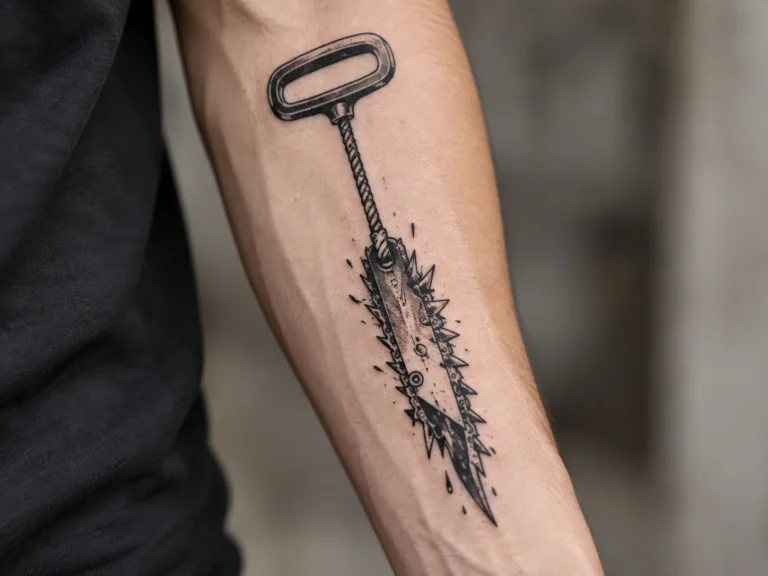
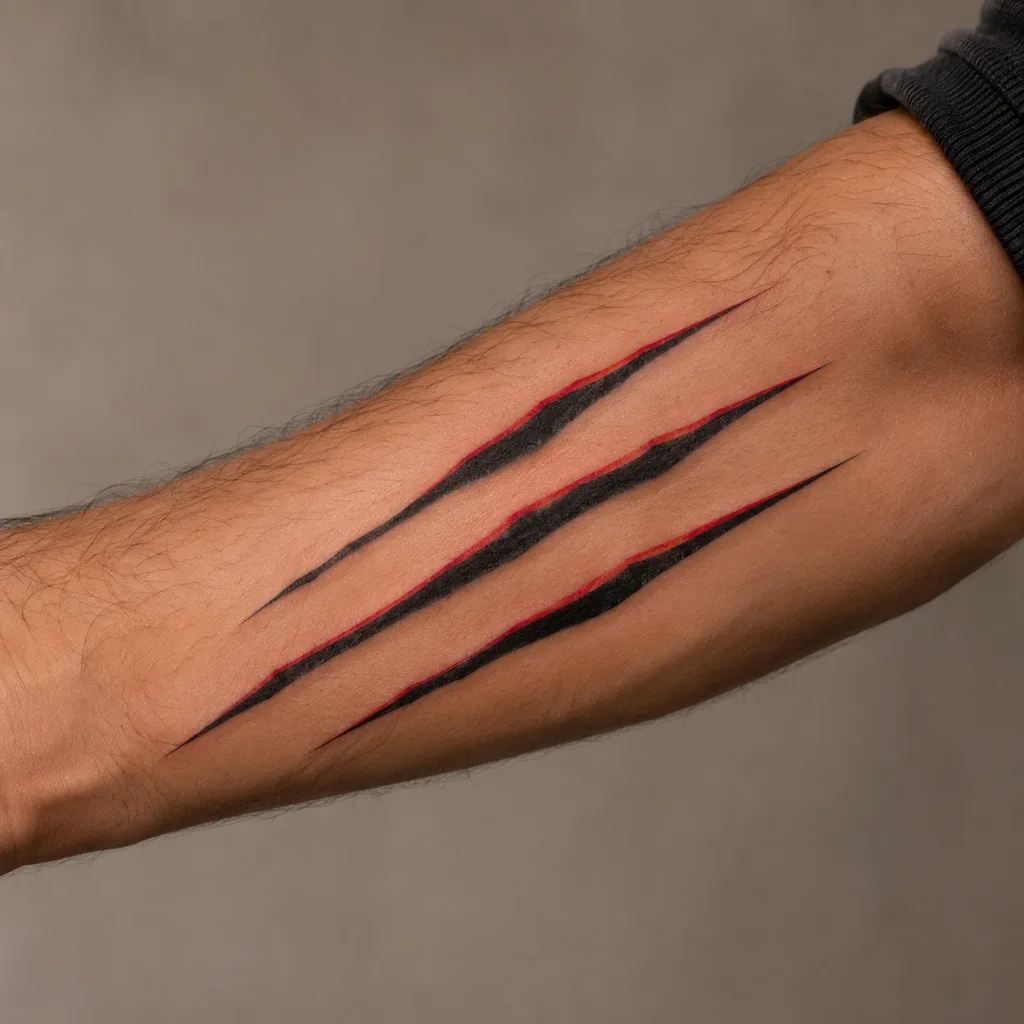
Sukuna’s signature attacks are Dismantle, a slashing cut, and Cleave, a cut that adjusts to its target. On skin they translate into clean diagonal slash lines: three parallel cuts across the forearm, or a crossing pair, with the line ends tapering to a point. It is the most graphic Sukuna idea and suits people who want movement more than a symbol. Keep a gap of a few millimeters between parallel lines so they don’t merge as they age.
- Size: 8 to 15 cm long
- Placement: outer forearm, calf, ribs
- Style: blackwork, optional thin red edge
7. The flame arrow
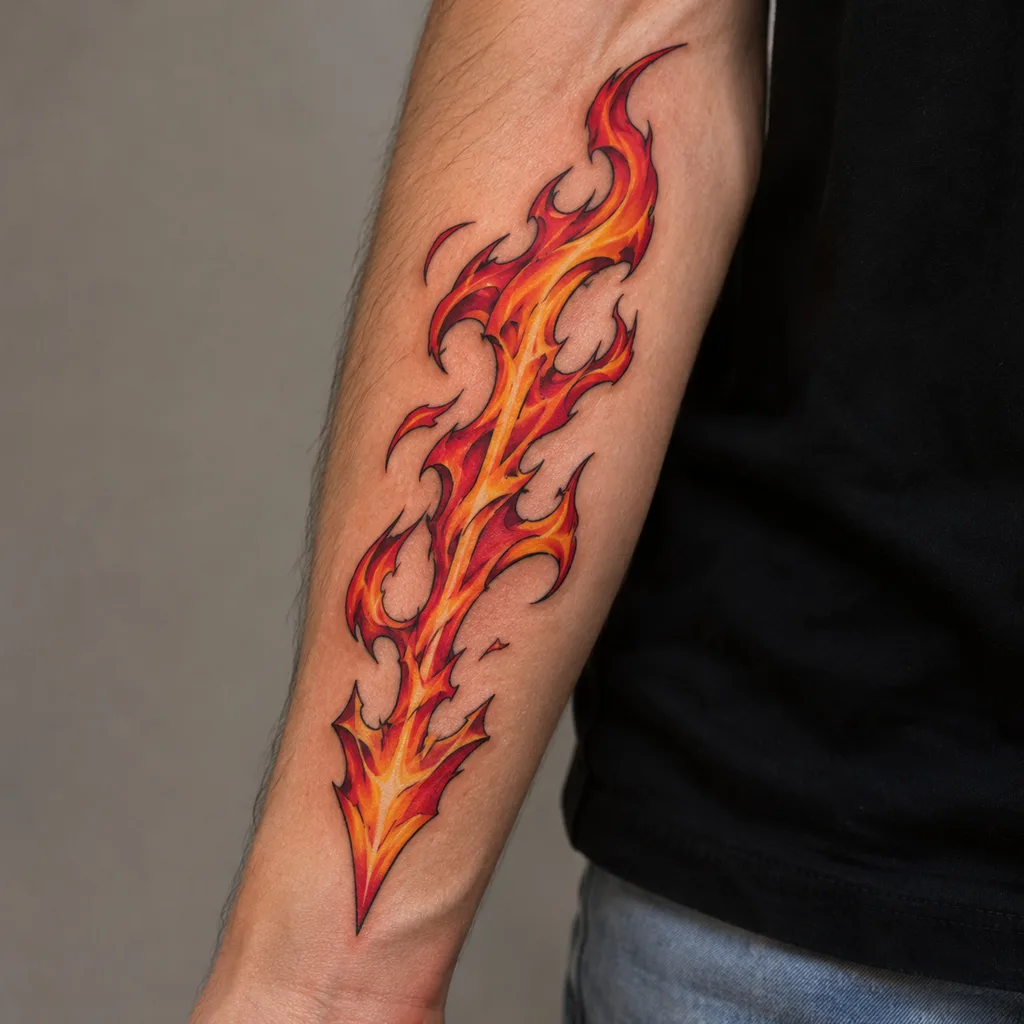
In his fight with Jogo, Sukuna draws a bow of fire and looses a flaming arrow, the technique fans call Fuga (“Open”). A single arrow trailing flame is one of the few Sukuna designs that works well in color, and it sits naturally along the length of the forearm or the side of the calf. If you prefer black ink, a flame drawn in solid black with negative-space highlights keeps the movement without the color fading.
- Size: 10 to 18 cm long
- Placement: inner forearm, side of the calf, spine
- Style: color (orange and red flame) or blackwork
8. His name in kanji
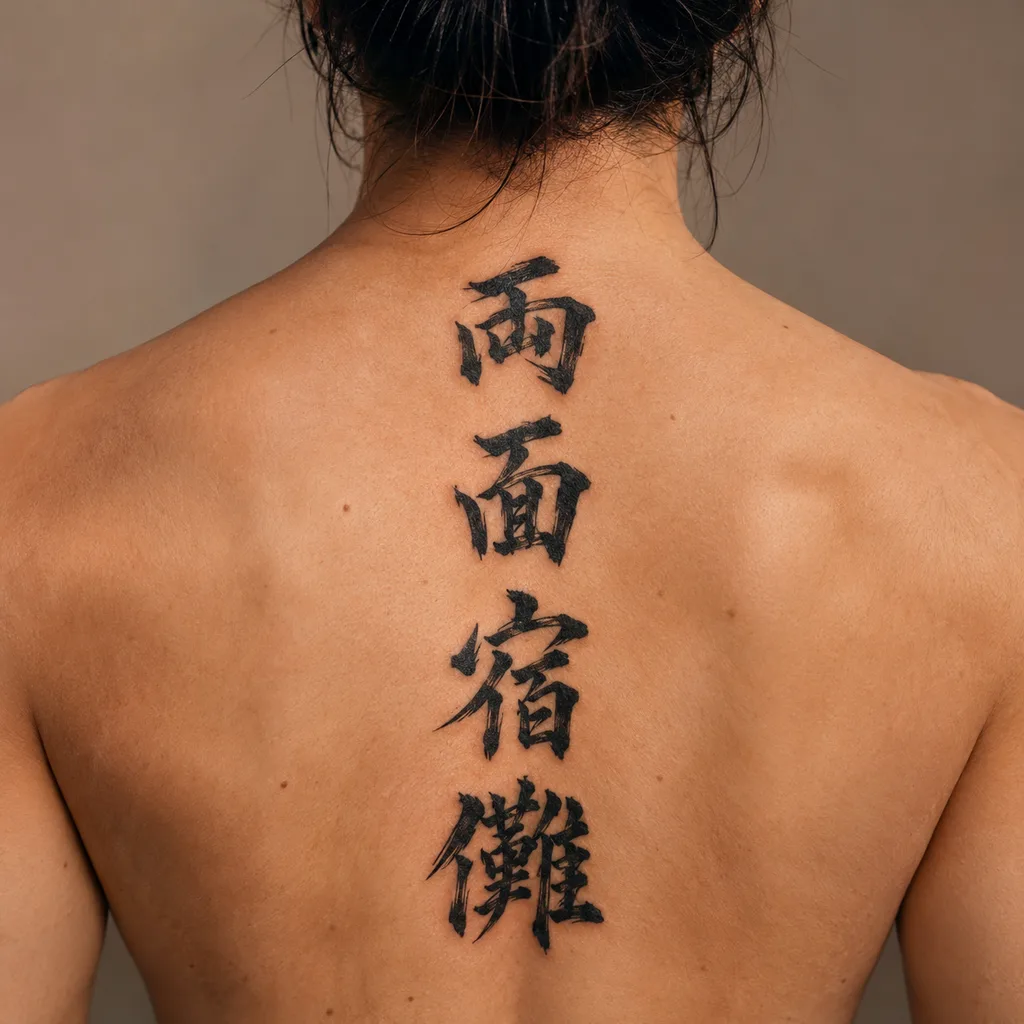
Sukuna’s full name is written 両面宿儺 (Ryōmen Sukuna). The name comes from a figure in Japanese chronicles, a two-faced, four-armed being from the Hida region, which is where the character’s extra eyes and arms come from. Set vertically, the four characters make a strong spine or forearm piece with meaning beyond the series. Have them checked by someone who reads Japanese before the stencil goes on, and ask for generous spacing so the strokes stay legible.
- Size: 10 to 18 cm tall
- Placement: spine, outer forearm, side of the ribs
- Style: brush-style blackwork
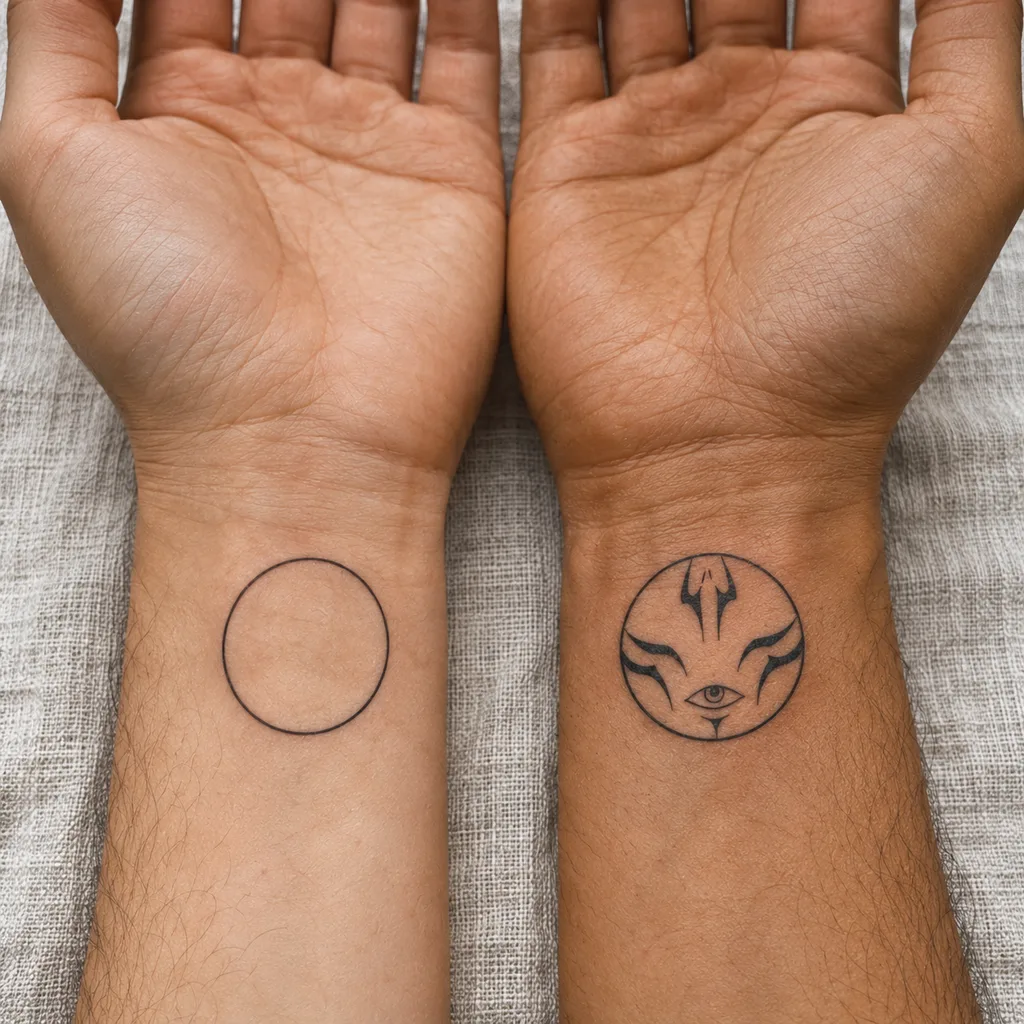
9. Yuji and Sukuna: a split design
Yuji and Sukuna share one body, and the series keeps returning to which of them is in control. A split design plays on that: a clean, unmarked half next to a half with Sukuna’s lines and an extra eye, or two matching tattoos for two people, one plain mark and one with the curse lines added. Done as a pair, it works for friends who argue about which side of the story they’re on.
- Size: 5 to 10 cm (single); 3 to 6 cm each (pair)
- Placement: forearm (single); matching wrists or ankles (pair)
- Style: fine-line for the plain half, blackwork for the marked half
Choosing Size and Placement for a Sukuna Tattoo
Sukuna designs split into line work that stays readable small (markings, bands, slashes, the finger) and pieces with internal detail that need room (the four eyes, the shrine, the kanji). The smallest sizes below are the point where the design still reads as itself, not a target to aim for.
| Design | Smallest size that stays readable | Good first placements | Best style |
|---|---|---|---|
| Facial markings (2 to 3 strokes) | 3 cm | Inner wrist, finger, behind the ear | Bold blackwork lines |
| Arm bands | 2 cm band width | Forearm, wrist, upper arm | Solid blackwork |
| Four eyes | 7 cm wide | Outer forearm, back of the arm | Blackwork, optional red iris |
| Cursed finger | 4 cm | Inner forearm, side of the hand, ankle | Black and grey, dotwork |
| Malevolent Shrine | 18 cm | Upper back, thigh | Blackwork with dotwork |
| Dismantle and Cleave slashes | 8 cm long | Outer forearm, calf, ribs | Blackwork |
| Flame arrow | 10 cm long | Inner forearm, calf, spine | Color or blackwork |
| Name in kanji | 10 cm tall | Spine, outer forearm, ribs | Brush-style blackwork |
| Yuji and Sukuna split | 5 cm (single), 3 cm each (pair) | Forearm; wrists or ankles | Fine-line plus blackwork |
Hand, finger and wrist placements are seen every day and tend to fade faster than the forearm because of friction and frequent washing, so expect touch-ups on the smallest designs. For more on how body areas compare, see our guides to the best placement for an anime tattoo and to forearm, wrist and sleeve designs.
Planning a Heavy Blackwork Piece
Most Sukuna designs lean on solid black, and that changes how you plan compared with fine-line work:
- Choose the artist by healed blackwork. Patchy fills and uneven band edges show more on healed skin than in fresh photos. Our guide to finding an anime tattoo artist covers what to look for in a portfolio.
- Expect longer sessions for larger fills. Arm bands and the shrine take longer than linework of the same size and may be split across sessions; read does an anime tattoo hurt before you book a long one.
- Budget for the black. Size and fill drive price more than the subject does (see how much an anime tattoo costs).
- Ask for a redrawn design built from several references, not a trace of one frame. See how to design a custom anime tattoo.
- Plan healing around movement. Bands that wrap a joint-adjacent area rub against sleeves and straps while they heal; our aftercare guide covers the steps.
FAQ
What is the most subtle Sukuna tattoo?
Two or three of his marking strokes on the wrist or finger, or a single cursed finger at a few centimeters. Both look abstract to most people and are recognizable to fans.
What does a Sukuna tattoo mean?
It depends on the design. The markings and four eyes point to the curse taking over, the fingers to power gathered piece by piece, Malevolent Shrine to dominance, and a Yuji and Sukuna split to the struggle between the two. Many fans choose Sukuna simply because he is the series’ most striking villain.
Can I get Sukuna’s markings without his face?
Yes. Most of the concepts above use the markings, bands, eyes or techniques on their own, which also makes them easier to scale and less dependent on an artist’s portrait skill.
Is a Sukuna arm band tattoo a good first tattoo?
It can be, if you are comfortable with solid black that wraps the arm and is hard to cover with short sleeves. A single small marking is a lower-commitment start, and bands can be added later.
Sukuna tattoo ideas on this page are original, fan-inspired concepts. InkShonen is an independent resource and is not affiliated with, endorsed by, or sponsored by the creators, publishers, or rights holders of Jujutsu Kaisen.
Related reading: Jujutsu Kaisen tattoo ideas for Megumi, Mahoraga, Nobara and more; Gojo tattoo ideas, from the blindfold to Hollow Purple; the hannya mask if you are drawn to demon imagery; anime eye tattoo ideas; and small anime tattoo ideas.