Torii Gate Tattoo Meaning
If you’ve been saving torii gate designs for months, you already know why the image works: two red uprights and a crossbeam, standing alone against sky or forest, marking a line between one world and another. That’s the whole appeal in a single frame. But before you sit down with an artist, torii gate tattoo meaning is worth understanding properly — what the symbol actually represents, whether the color you choose changes that meaning, where it works best on the body, and whether there’s anything you should think through first if you’re not Japanese. This article covers all of it — the real cultural meaning, the practical design decisions, and the respect question most guides skip entirely.
What a Torii Gate Actually Is
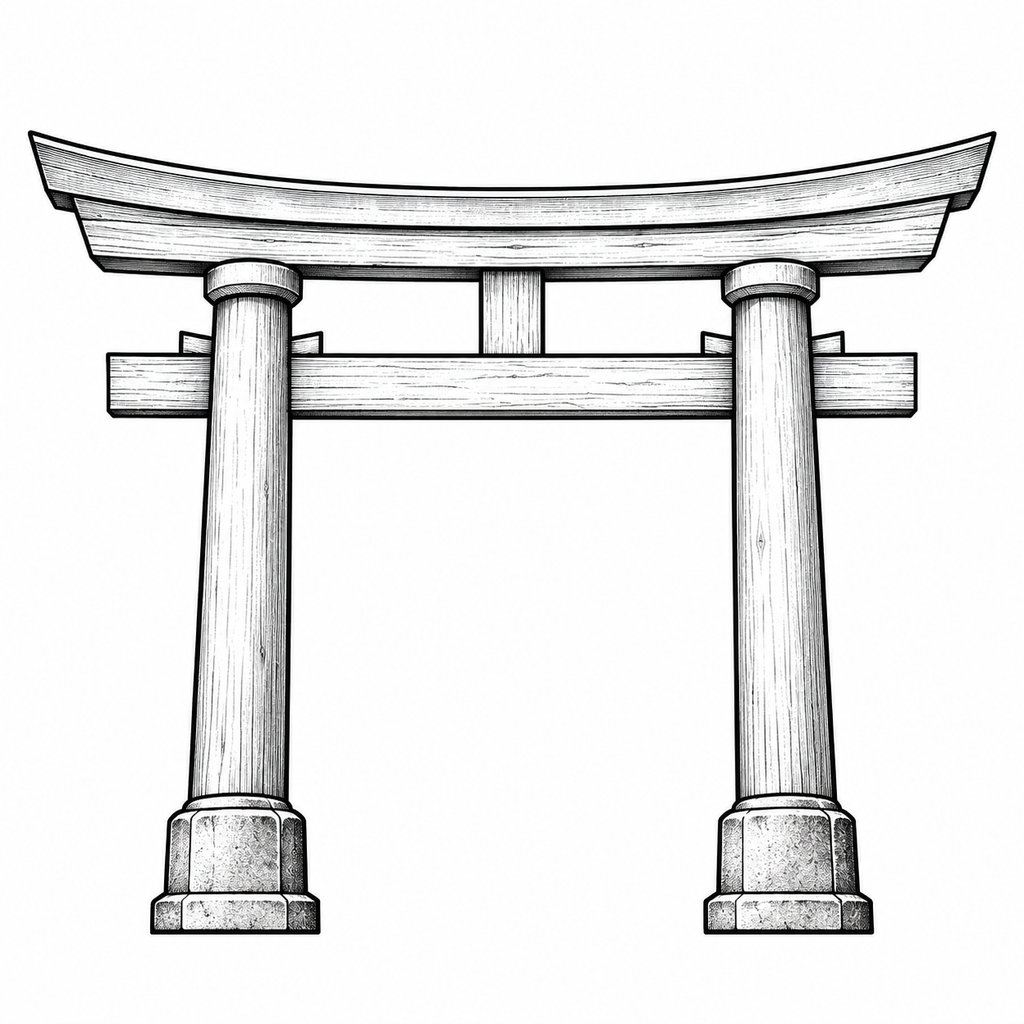
A torii is a gate that marks the entrance to a Shinto shrine. Structurally, it’s simple: two upright posts topped by one or two horizontal crossbeams, often with a second, shorter beam just below the top one. No walls, no doors — just the frame itself, standing alone or repeated in a long series along a shrine path.
What makes a torii meaningful isn’t the structure, it’s what it marks. Passing through one is understood as moving from ordinary space into sacred space, where kami (the spirits or deities central to Shinto belief) are considered present. The gate itself isn’t worshipped — it’s a marker, a line drawn between the everyday world on one side and something set apart on the other.
The most recognizable torii in the world are probably the vermilion gates at Fushimi Inari Taisha in Kyoto, where thousands of them form a tunnel up the mountain, each one donated by a person or business as an act of gratitude or petition. That image — a single frame repeated into a corridor — is part of why the shape translates so well into a tattoo: it reads clearly even reduced to one gate, one line, one threshold.
Torii gates predate any anime or pop-culture use of them by centuries. They’re a living part of Shinto practice today, not a historical relic or a fictional design element — a distinction worth keeping in mind as you read the rest of this guide, and one that shapes how the appropriation question further down should actually be approached.
What a Torii Gate Tattoo Symbolizes
Tattooed, a torii gate typically carries the meaning it has architecturally: a threshold. It represents crossing from one state into another — leaving something behind and stepping into what’s next. That’s why it resonates with people marking a real transition in their own life: a recovery, a move, the end of one chapter and the start of another.
Beyond transition, a torii gate is often read as a symbol of protection. Since it marks the boundary of sacred ground, wearing one can carry the sense of standing at, or guarding, a threshold — a marker that something meaningful lies on the other side of it, and that the wearer has consciously stepped through.
Because the gate is a frame rather than a scene, it also works well as a symbol on its own, without needing additional imagery to complete the idea. A solitary torii against negative space communicates the “passage” meaning clearly, which is part of why it appears so often as a minimalist tattoo choice. That said, it’s flexible enough to anchor a much larger piece too — the sections below on design pairings cover how it typically gets combined with other motifs once someone wants more than a standalone symbol.
Does Color and Material Change the Meaning?
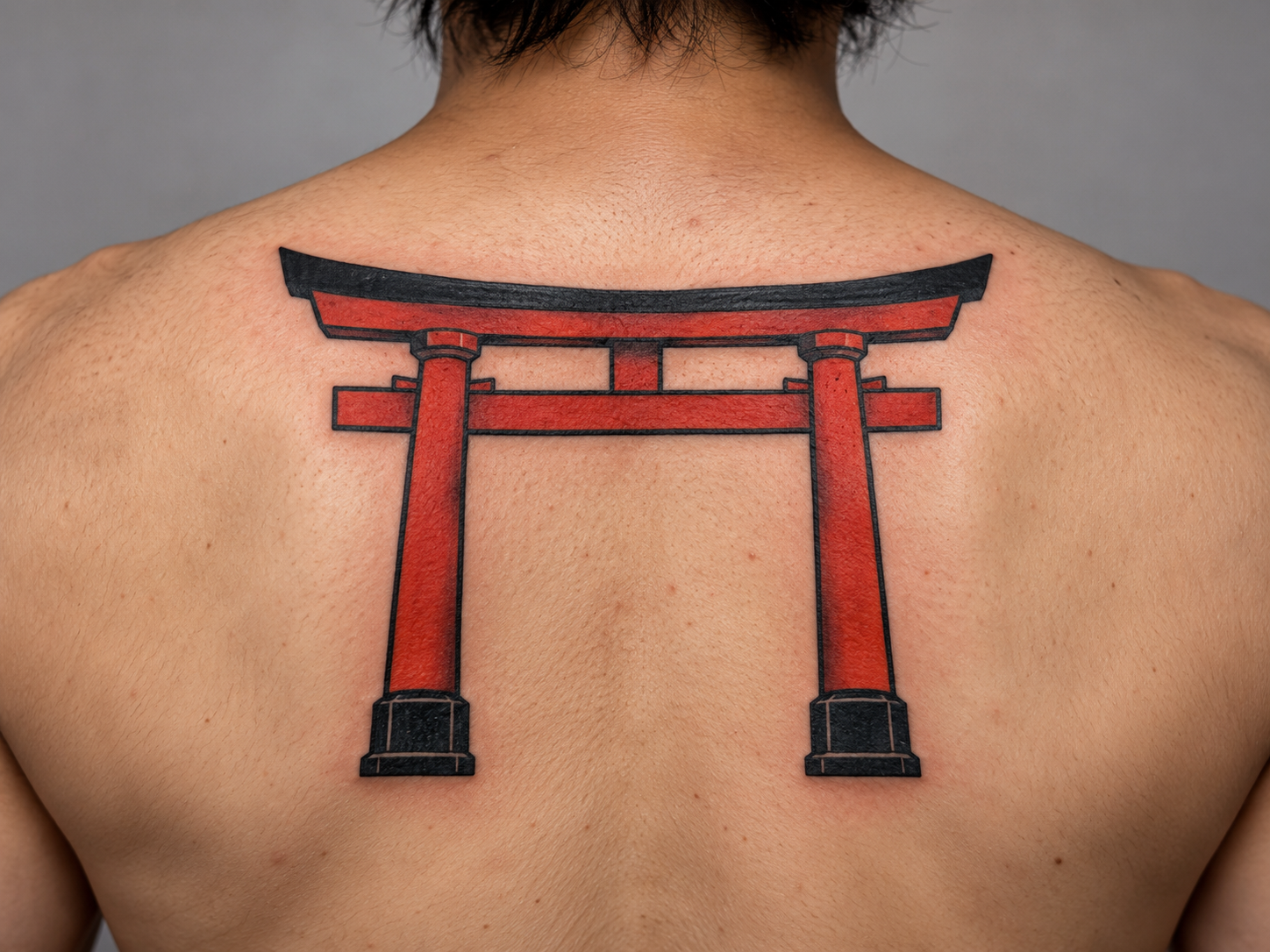
Yes, to a degree. The two design choices searchers ask about most are vermilion (the traditional red-orange) and plain, unpainted wood or stone.
| Choice | Common reading |
|---|---|
| Vermilion / red | The traditional shrine color. Associated with protection and vitality, and the version most people picture first — it’s the color used at Fushimi Inari and most torii built in the vermilion style. |
| Unpainted wood or stone | A plainer, more austere look. Reads as more grounded and naturalistic, leaning into the gate’s architecture rather than its ceremonial color. |
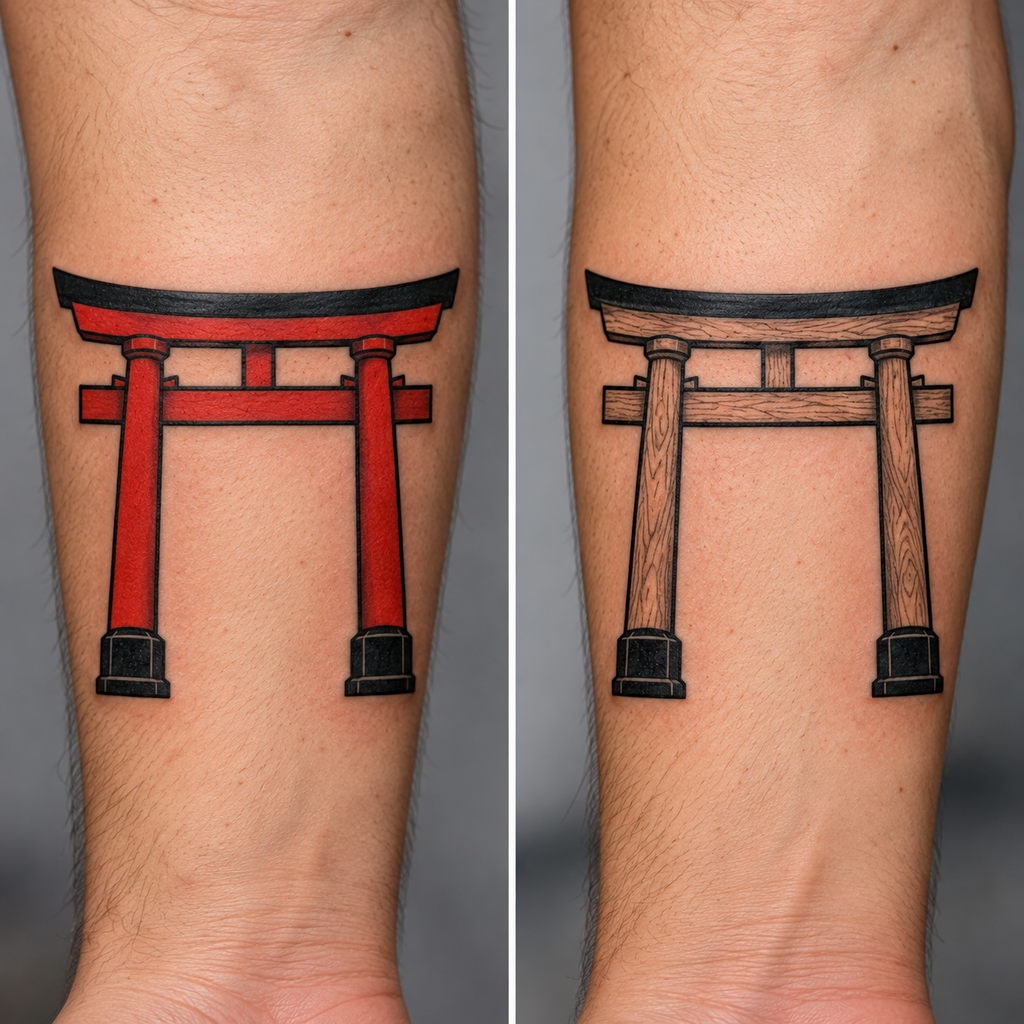
Neither choice is more “correct” than the other — both exist on real shrines, and the decision mostly comes down to the visual style you want (bold and traditional versus muted and minimal) rather than a difference in underlying symbolism. If you’re pairing the gate with other motifs (see Common Design Pairings below), vermilion tends to hold its own against busier compositions, while unpainted wood or stone often reads better in a quieter, more linework-driven piece.
Is It Disrespectful or Appropriative to Get This Tattoo?
This is a fair question to ask, and it deserves a direct answer rather than a dismissive one. A torii gate isn’t fictional IP — it’s a real, currently-used religious symbol tied to Shinto practice. That doesn’t mean it’s off-limits to get tattooed, but it does mean it’s worth approaching thoughtfully rather than treating it as a purely decorative shape.
A few things generally considered good practice: understand what the symbol actually represents before you get it (which is the point of this article), avoid combining it with imagery that mocks or trivializes it, and work with an artist who has real experience with Japanese-style (irezumi) work and can speak to the visual conventions involved. None of this is a legal rule or a religious ruling — it’s general guidance on approaching a real cultural symbol with the same care you’d want applied to a symbol from your own background. If you’re still unsure, talking it through with your artist before the appointment is a reasonable step.
Style choice factors into this too, in a practical sense. A torii gate rendered in traditional irezumi style — bold outlines, solid color fill, often as part of a larger composition — sits within a specific, established tattooing tradition, and an artist who works in that tradition will usually understand the visual conventions and pairings that go with it. A fine-line or minimalist version of the same gate is a different visual approach entirely, closer to the standalone symbol described earlier, and doesn’t carry the same stylistic expectations. Neither approach is more or less respectful on its own — the substance of the guidance above is about understanding and intent, not which line weight you choose.
Best Placements for a Torii Gate Tattoo
Two placements come up most often, for different reasons.
| Placement | Why it works |
|---|---|
| Back | Gives the design room to sit at real scale, which suits the gate’s architectural proportions. The spine also echoes the gate’s own vertical “threshold” symbolism — a line the eye follows top to bottom. |
| Forearm or sleeve | Keeps the design visible day to day and integrates naturally into a larger Japanese-style sleeve, where a torii gate is often used as one framing element among several. |

Smaller versions also work on the wrist or behind the ear for people who want the symbol without a large piece, since the gate’s simple linework holds up even at reduced scale — though at very small sizes, fine detail like the second crossbeam can get lost, which is worth discussing with your artist. As a rough rule of thumb: the larger and more traditional-irezumi the design, the more the back rewards it; the simpler and more fine-line the design, the more freedom you have to place it somewhere smaller and more visible, like the forearm or wrist.
Common Design Pairings
A torii gate is rarely tattooed in complete isolation in larger pieces — it’s often combined with other motifs that build on its meaning:
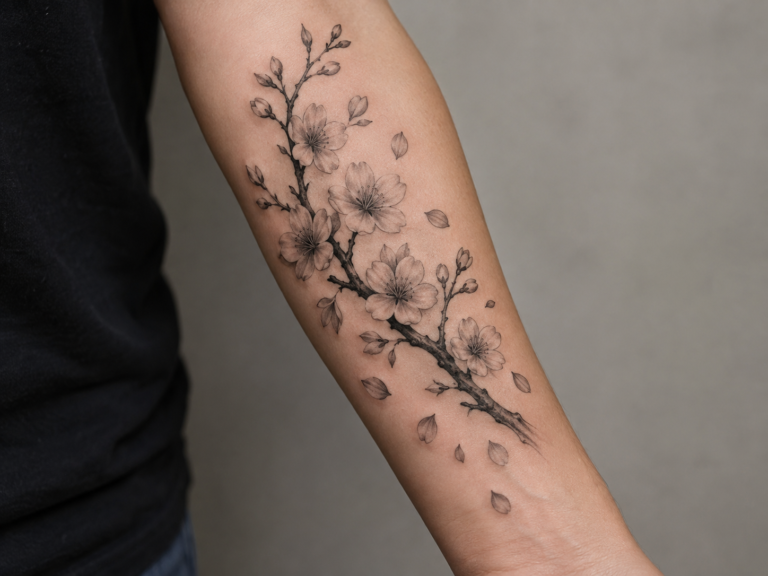
- Cherry blossoms — pair the gate’s “threshold” symbolism with impermanence and the beauty of a fleeting moment, a common combination in Japanese-style sleeves. Where the gate marks a passage, the blossoms remind the viewer that what’s on either side of it doesn’t last forever either.
- The moon — adds a nighttime, spiritual register to the piece, reinforcing the gate’s association with the sacred and unseen. A torii silhouetted against a full moon is one of the more atmospheric ways to render the symbol, leaning into mood rather than just structure.
- Mount Fuji — combines two of the most recognizable markers of Japanese landscape and spirituality into one composition, often used to root the piece in a specific sense of place rather than an abstract symbol floating in empty space.
- A dragon — brings power and protection into the piece, layering onto the gate’s own protective symbolism rather than competing with it. This pairing tends to work best in larger, traditional-irezumi compositions where there’s enough room for both elements to read clearly.

Each of these pairings adds something specific rather than just filling space, which is worth discussing with your artist if you’re planning a larger piece built around the gate. None of them are required — a standalone torii, as covered earlier, communicates its own meaning perfectly well without any of them.
FAQ
Is it disrespectful or cultural appropriation to get a torii gate tattoo if you’re not Japanese? It’s not inherently off-limits, but it’s worth approaching with real understanding of what the symbol means rather than treating it as pure decoration. Learning the meaning, avoiding disrespectful combinations, and working with an artist experienced in Japanese-style work are generally considered reasonable steps.
What does the color of a torii gate mean (red/vermilion vs. plain wood or stone)? Vermilion is the traditional shrine color, tied to protection and vitality, and the most commonly pictured version. Unpainted wood or stone is plainer and more naturalistic. Both are authentic choices — the difference is mostly visual style, not underlying meaning.
Where is the best placement for a torii gate tattoo — back, arm, or forearm? The back suits the design’s proportions and echoes its vertical symbolism at full scale. The forearm or as part of a sleeve keeps it visible and integrates well with other Japanese-style motifs. Both are common choices for different reasons.
What does a torii gate tattoo mean when combined with cherry blossoms or a dragon? Cherry blossoms add a note of impermanence and beauty to the gate’s threshold symbolism. A dragon adds power and protection, reinforcing rather than competing with the gate’s own protective meaning. Both are common, well-established pairings rather than arbitrary additions.
Explore more Symbols & Meanings guides, including Spider Lily (Higanbana) Tattoo Meaning, Cherry Blossom Tattoo Meaning, Kitsune Mask Tattoo Meaning, and Hannya Mask Tattoo Meaning.