Cherry Blossom Tattoo Meaning: Symbolism, Culture, and Design
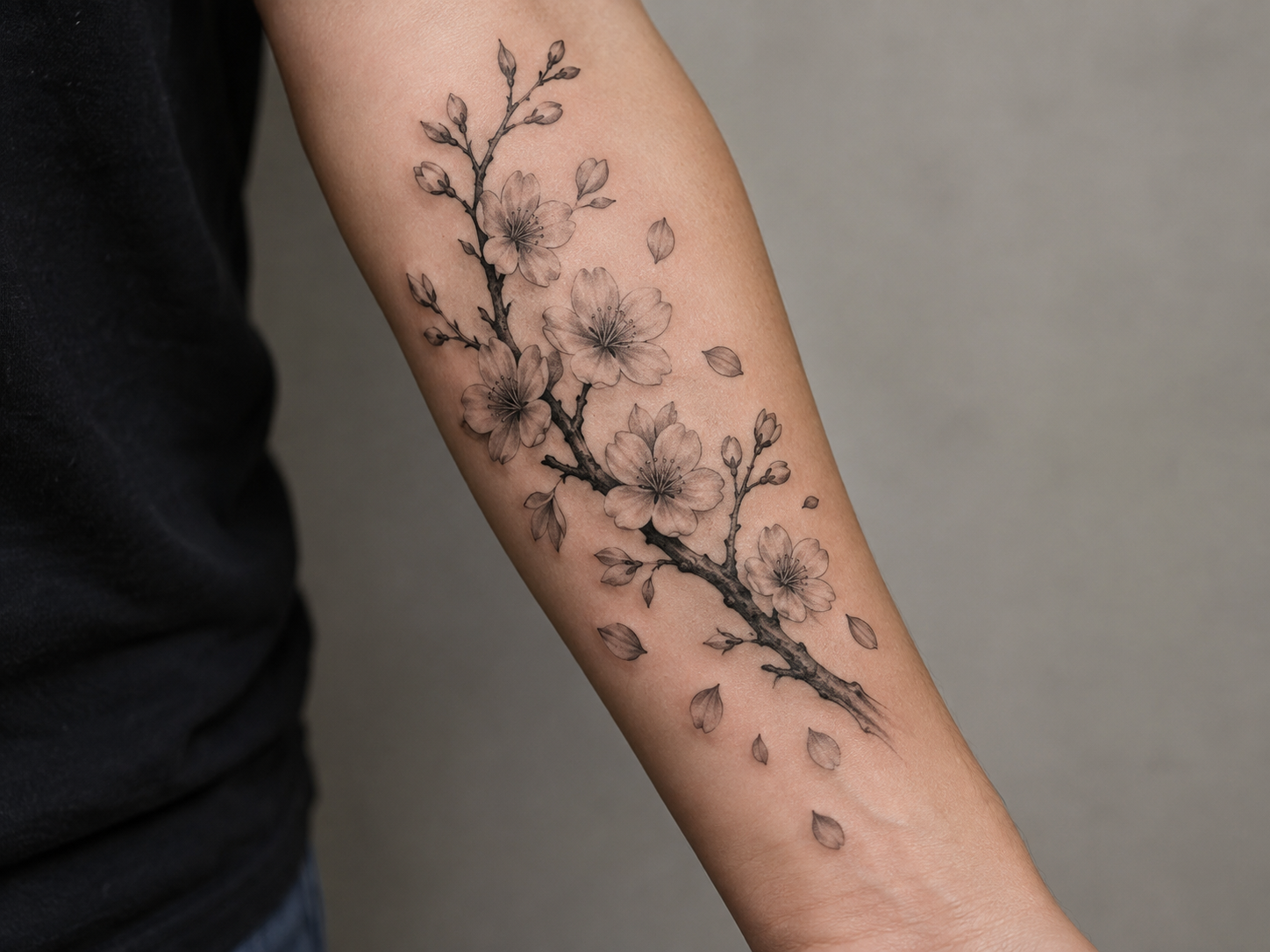
A cherry blossom tattoo is one of the most requested floral designs in tattooing, and also one of the most misunderstood. Most people know it looks good. Fewer know what it’s actually saying. The short answer: a cherry blossom tattoo is about impermanence, the idea that something is more beautiful, not less, because it doesn’t last. That one-line answer hides real depth once you look at where the meaning comes from, how the design itself changes what the tattoo communicates, and how different cultures interpret the same flower in genuinely different ways.
This guide covers all of it: the core meaning and its real cultural roots, why the flower shows up constantly in anime, how a single falling petal says something different than a full branch, and what changes (and doesn’t) as you cross from Japan to China to Korea.
What Does a Cherry Blossom (Sakura) Tattoo Mean?
At its core, a cherry blossom tattoo represents impermanence: the idea that life, beauty, and specific moments are temporary, and that this temporariness is exactly what makes them worth noticing.
This idea has a name in Japanese aesthetics: mono no aware, often translated as “the pathos of things” or “the bittersweet awareness of impermanence.” According to Georgetown University’s Berkley Center for Religion, Peace and World Affairs, mono no aware describes a heightened sensitivity to the transience of all things: not sadness exactly, but a kind of appreciation that gets sharper because you know something won’t last. The concept traces back to Shinto belief, with Buddhist philosophy later deepening its focus on transience.
Cherry blossoms are the reference point most people reach for when they try to explain mono no aware, and it’s easy to see why. The trees bloom intensely for a matter of days, then drop their petals all at once. There’s no long decline, just a short, full display followed by an ending. That compressed timeline is the whole point. A cherry blossom tattoo, at its most basic, is a way of carrying that idea on your skin: this moment, this stage of life, this person, mattered more because it didn’t last forever.
That’s different from a tattoo that simply means “beauty” or “nature.” A cherry blossom tattoo is specifically about beauty that is aware of its own ending, which is why it shows up so often as a memorial piece, a marker of a major life change, or a reminder to stay present, rather than as a generic decorative flower.
Why Cherry Blossoms Are a Recurring Symbol in Anime
Falling cherry blossom imagery shows up constantly in anime, and it’s rarely just background scenery. A scene set beneath falling petals is usually doing narrative work: marking a goodbye, a death, a graduation, or a shift from one chapter of a character’s life to the next. The visual and the meaning are the same one described above, a beautiful moment ending as you watch it, which is why this imagery gets used so often when a story needs to signal that something significant and irreversible is happening.
That overlap is also what makes cherry blossom tattoos a natural fit for anime fans specifically, beyond the flower’s general popularity. If you’ve watched enough anime, you’ve likely already felt what falling petals mean emotionally before ever learning the term mono no aware. The visual language and the underlying philosophy are the same thing. A cherry blossom tattoo lets you carry that specific kind of meaning without needing to reference any single show, character, or scene. It reads less as “this is from my favorite anime” and more as “this is the feeling my favorite anime keeps coming back to.”
Cherry Blossom Tattoo Meaning by Design
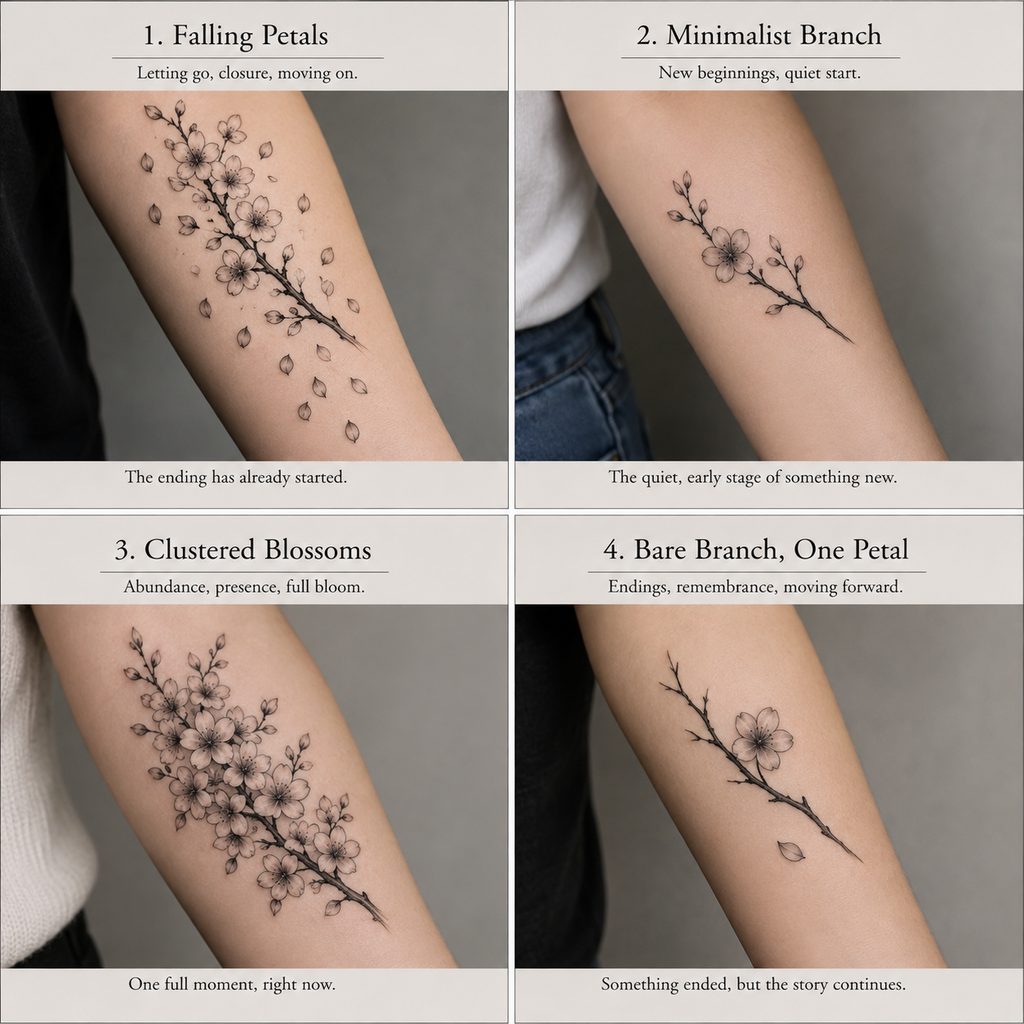
The core meaning of a cherry blossom tattoo doesn’t change based on design, but the specific message does. How the flower is arranged says something different about where you are in the story impermanence is telling.
Falling Petals
A design built around petals actively falling, mid-air, drifting, scattered around the branch rather than sitting neatly on it, leans hardest into the “letting go” side of the meaning. This version is most associated with grief, closure, or moving on from something specific. It’s a design that says the ending has already started.
Minimalist Branch
A small, simple branch with only two or three blossoms reads differently. Rather than emphasizing an ending, it points toward a beginning: the quiet, early stage of something new rather than the dramatic tail end of something finished. This is a common choice for a first tattoo, or for marking the start of a change rather than its conclusion.
Clustered Blossoms
A fuller branch, dense with blossoms all in the same stage of bloom, shifts the meaning toward abundance and presence rather than transition in either direction. This design says less about beginnings or endings and more about one specific, full moment: a way of marking “this is what things looked like” rather than “this is what’s changing.”
Bare Branch, One Petal
The starkest version: a mostly bare branch with a single remaining petal, or one petal falling from an otherwise empty branch. This design sits closest to loss specifically, rather than change in general. It’s the version most people choose when the tattoo is about one particular ending, a person, a relationship, a period of life, rather than impermanence as a broad idea.
None of these readings are rules enforced by tradition. They’re patterns in how the same base symbol gets pushed toward a more specific message depending on what’s actually drawn. If you’re choosing a design, decide first which of these four ideas, letting go, beginning, presence, or specific loss, is the one you actually want on your skin, then pick the composition that matches it.
Cherry Blossom Symbolism Across Cultures
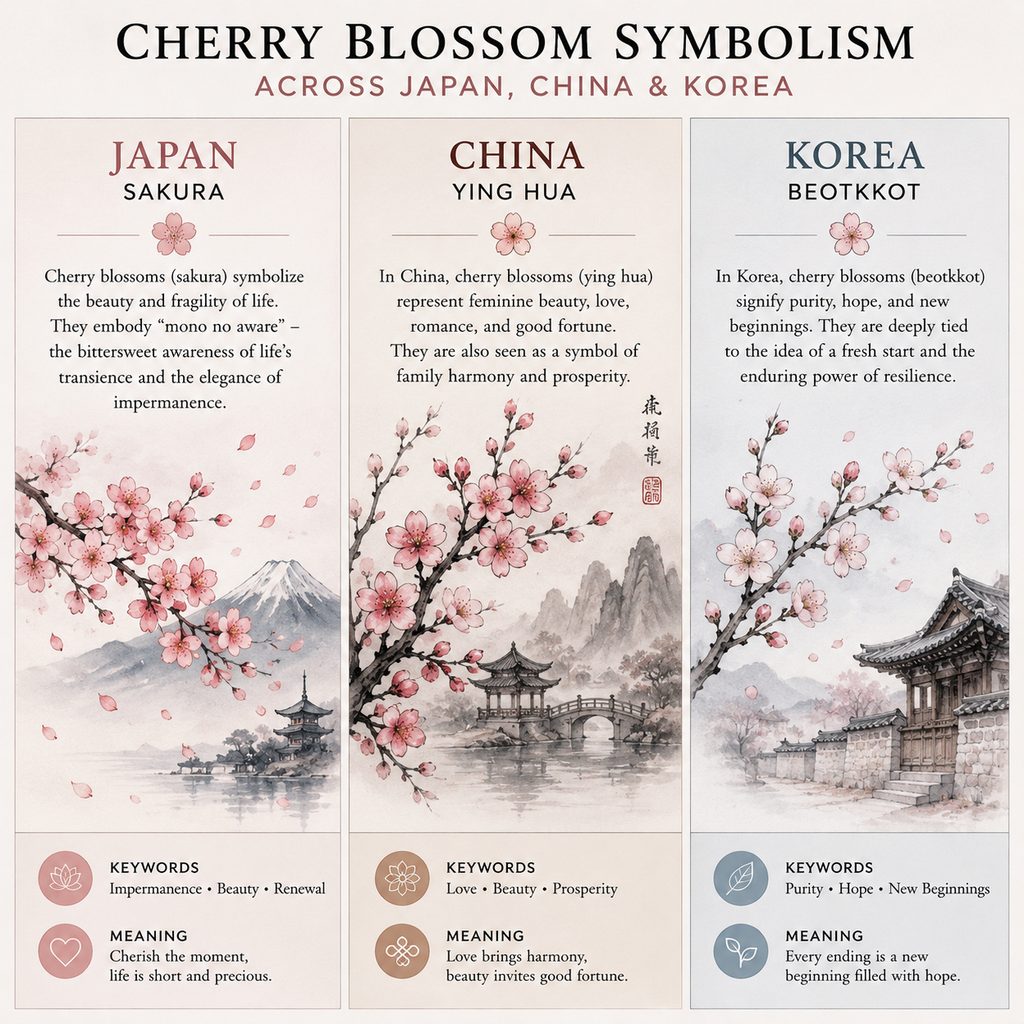
Cherry blossom symbolism is often treated as one universal idea, but it isn’t. Japan’s version is the deepest and best documented. China’s and Korea’s are real, but different, and smaller than a lot of tattoo content implies. They’re worth understanding accurately rather than assuming the Japanese meaning simply transfers everywhere the tree grows.
Japan
Beyond mono no aware, cherry blossoms carry a specific connection to samurai culture. A Japanese proverb dating to the medieval period, “hana wa sakuragi, hito wa bushi,” roughly “among blossoms, the cherry blossom; among men, the warrior,” placed the cherry blossom as the finest of flowers the same way it placed the samurai as the finest of men. Historian Catharina Blomberg, in her study of samurai culture The Heart of the Warrior, traces the comparison further than simple admiration: a samurai’s life, like a falling petal, could end suddenly and completely at its peak, and that sudden, complete ending was framed as something to accept rather than fear. This association became especially well known through kabuki theater in the mid-Edo period, which is also where the proverb itself was popularized. Japan also marks the season itself with hanami, the tradition of gathering specifically to view the blossoms while they last, a practical, communal version of the same idea the tattoo represents.
China
Cherry blossom symbolism in China is real but comparatively minor, and it’s often overstated in tattoo content that treats it as equivalent to Japan’s. As surveys of classical Chinese poetry, including coverage by the cultural magazine The World of Chinese, document, cherry blossom doesn’t rank among China’s major symbolic flowers. That role belongs to peach blossom, tied to beauty and romance, and to plum blossom and pine, both associated with perseverance and integrity for their ability to endure winter. Cherry blossom, by contrast, grew wild in the mountains rather than being cultivated, and Tang and Song dynasty poets more often used it to evoke loneliness and solitude rather than romance or resilience. A cherry blossom tattoo drawing specifically on Chinese symbolism is closer to quiet isolation than to strength or independence.
Korea
Korea’s relationship with the cherry blossom is shaped by a difficult colonial history rather than long-standing tradition. South Korea’s actual national flower is the mugunghwa, or hibiscus, a flower that carried real patriotic weight and was, for that reason, specifically targeted during Japan’s colonial occupation of Korea (1910 to 1945). Historian David Fedman’s research on Japanese forestry practices in colonial Korea documents how colonial authorities uprooted mugunghwa as a symbol of Korean identity and replaced it with Yoshino cherry trees as part of a broader effort to reshape Korean culture. Many of those colonial-era trees were removed after liberation in 1945, and Korea’s own native cherry variety exists independently of the Japanese Yoshino. In the decades since, cherry blossom season has been gradually reclaimed as a normal, joyful part of the Korean spring, but its history there is about colonization and cultural reclamation, not a native patriotic symbol.
Cherry Blossom Tattoo Combinations and What They Add
A cherry blossom rarely appears completely alone in tattoo design, and pairing it with another image is a straightforward way to add a second layer of meaning.
Cherry blossoms combined with a koi fish are a common pairing, and the two symbols work well together because they pull in different directions: the koi represents perseverance and pushing forward against difficulty, while the blossoms represent acceptance of what can’t be controlled. Together, the pairing reads as strength alongside acceptance, rather than one replacing the other.
Cherry blossoms with water or wave elements lean into a related idea: flowing with change rather than resisting it, since both petals and water move constantly and can’t be held in place.
Cherry blossoms paired with a short script or quote are a more personal option, usually used to anchor the general idea of impermanence to something specific: a name, a date, or a phrase that only means something to the person wearing it.
FAQ
What does a cherry blossom tattoo symbolize?
At its core, it represents impermanence: the idea that something is more meaningful because it doesn’t last, rooted in the Japanese concept of mono no aware. Beyond that base meaning, it can also point to renewal, a major transition, or remembrance, depending on the design and the reason behind it.
Can anyone get a cherry blossom tattoo?
Yes. The flower’s core meaning around impermanence isn’t exclusive to any one group, and cherry trees themselves grow and hold cultural meaning across Japan, China, and Korea. That said, it’s worth understanding the real cultural weight behind the design you choose rather than treating it as a purely decorative flower. See the note on cultural appropriation below.
Does the color of a cherry blossom tattoo change its meaning?
The core symbolism stays the same regardless of color choice; color is a style decision, not a meaning decision. Traditional pink shades keep the design closest to how the flower actually appears in bloom. Black-and-grey or single-line versions strip the design down to its outline, which some people prefer specifically because it keeps the focus on shape and composition rather than a realistic color palette.
Is it cultural appropriation to get a cherry blossom tattoo if you’re not Japanese?
This deserves a real answer rather than a dismissal in either direction. The cherry blossom itself isn’t a closed or sacred symbol the way some religious imagery is. It’s a flower that blooms across several countries and carries different cultural meanings in each one, and getting a tattoo of a flower isn’t the same as adopting a closed cultural or religious practice. That said, the concept of mono no aware specifically is a Japanese philosophical idea with real depth behind it, and a tattoo referencing it means more, and reads as more respectful, if you actually understand what it’s referencing rather than treating it as a generic “deep” flower. The honest approach is less about whether you’re allowed to get the tattoo and more about doing the reading first.
A cherry blossom tattoo can mean several real things at once: impermanence, a specific loss, a beginning, a moment worth remembering. Which one it says depends more on the design than most people realize. The flower’s cultural weight is real in Japan, genuine but smaller in China, and shaped by a difficult colonial history in Korea. Understanding those differences, rather than treating the symbol as one universal idea, is what turns a cherry blossom tattoo from a nice-looking flower into something that actually means what you intended it to.